
Govee Indoor Hygrometer Thermometer 2Pack
4.5Editor score
Bluetooth app control with alerts
Large LCD display with comfort indicators
Free data storage and export
This comprehensive guide compares the top 10 grow room monitoring systems for temperature, humidity, and VPD to help you optimize your indoor cultivation
Growing plants indoors requires precise environmental control to ensure healthy development and maximum yields. Proper monitoring of temperature, humidity, and other factors is essential for preventing stress and disease in your grow space.
We evaluated ten top-rated monitoring devices based on accuracy, connectivity features, and ease of use. Our analysis includes smart sensors, WiFi-enabled units, and specialized tools designed for serious indoor growers.
Each selection highlights key capabilities like app integration, data storage, and alert systems. Note that prices and availability change frequently, so verify current details before purchasing any equipment for your setup.
4.5Editor score

5.0Editor score

4.6Editor score
The following table provides a side-by-side comparison of all ten monitoring solutions to help you quickly identify which device fits your specific cultivation needs and budget constraints.




The Pulse One stands out as a top-tier solution for growers who need detailed climate control. It earns a perfect rating for its ability to track VPD, temperature, humidity, light, and dew point in one unified dashboard.
We may earn a commission when you buy through this link, at no additional cost to you.
This system boosts yields by preventing crop loss through precise monitoring. The unlimited sensor support allows you to place units anywhere while maintaining a single connection hub. Offline data storage ensures records are never lost.
While the price is higher than basic hygrometers, the professional features justify the investment. The splash-resistant design and long battery life make it practical for humid indoor gardens where condensation occurs frequently.
Growers aiming for consistency and optimization should choose this device. Its reliability and comprehensive reporting capabilities make it the best choice for serious cultivation projects requiring detailed environmental insights.
Track all critical factors including VPD and light intensity from a single device.
Expand your monitoring network without limits to cover every corner of your grow space.
We may earn a commission when you buy through this link, at no additional cost to you.
This 2-pack offers exceptional value for monitoring multiple zones without breaking the bank. With a high rating for ease of use, it delivers real-time temperature and humidity readings via a user-friendly app interface.
We may earn a commission when you buy through this link, at no additional cost to you.
The Swiss-made sensor ensures accurate readings refreshed every two seconds. The large LCD screen displays comfort levels at a glance. You can export two years of data for detailed analysis of climate trends.
The main limitation is the Bluetooth connection range which restricts remote access. However, the low cost makes it easy to buy additional units to place closer to your phone or router.
Ideal for budget-conscious growers needing basic monitoring. The inclusion of two units allows immediate multi-zone coverage while you upgrade to WiFi models later as your setup expands.
Receive two devices immediately to monitor separate areas of your grow room.
Export historical data to CSV format for deep analysis of environmental patterns.
We may earn a commission when you buy through this link, at no additional cost to you.
This system brings high-end reliability with a massive range and gateway control. It achieves a 4.6 rating for its ability to penetrate walls and cover entire buildings with a single network connection.
We may earn a commission when you buy through this link, at no additional cost to you.
The precision sensor offers lab-grade accuracy for sensitive applications. You receive instant notifications via multiple channels. The large screen provides clear visibility of comfort status without needing a phone.
While the gateway adds complexity, the range benefits are unmatched for large setups. The battery life remains robust even with gateway integration. It is a premium choice for serious home climate management.
Best for those needing whole-home or whole-grow coverage. The combination of range, precision, and multi-channel alerts makes it a reliable investment for critical environmental stability.
Achieve up to 1640 feet range to monitor remote areas without dead zones.
Receive notifications via push, email, app, and buzzer to never miss critical changes.
We may earn a commission when you buy through this link, at no additional cost to you.
This device is designed for growers using the VIVOSUN ecosystem. It connects seamlessly with other SGS devices to provide a unified view of your climate. The app delivers alerts to keep conditions stable remotely.
We may earn a commission when you buy through this link, at no additional cost to you.
The dual channel feature allows you to monitor two distinct areas or data points. The visual VPD design helps interpret complex data quickly. You can export data for review to fine-tune your climate control strategy.
The reliance on Bluetooth limits remote access unless a gateway is used. However, it remains affordable and effective for local monitoring. The design ensures readings are clear and easy to understand.
Ideal for those already invested in VIVOSUN hardware. The integration and specific focus on grow metrics make it a practical choice for dedicated indoor cultivation setups.
Works with other VIVOSUN devices to build a comprehensive monitoring network.
View VPD data directly on the screen to simplify complex climate decisions.
We may earn a commission when you buy through this link, at no additional cost to you.
This hygrometer uses a corded probe to measure remote locations accurately. It connects to an app that allows you to track climate trends and receive alarms. The screen provides clear visibility in low light.
We may earn a commission when you buy through this link, at no additional cost to you.
The daily highs and lows feature helps you identify extreme fluctuations. The magnetic and wall mounting options give flexibility in placement. CSV charts allow you to visualize data over time.
Bluetooth connectivity restricts remote viewing when away from home. However, the precision of the probe is ideal for specific spot monitoring. It serves well for targeted environmental checks.
Best for growers who need accurate spot data. The corded probe design ensures readings from hard-to-reach spots are consistent and reliable.
Use the corded probe to measure specific areas away from the main unit.
Export CSV charts to see long-term trends and plan climate adjustments.
We may earn a commission when you buy through this link, at no additional cost to you.
This model features an electronic ink display that significantly extends battery life. It connects to your home network to allow remote access to climate data. You can set alerts to get notified of changes instantly.
We may earn a commission when you buy through this link, at no additional cost to you.
The sensor refreshes every two seconds to keep data fresh. The screen is easy to read from various angles. You can export data over the past two years for historical analysis.
It does not support 5G networks which may limit router compatibility. Also, e-ink screens have a slight lag compared to standard LCDs. These are minor trade-offs for the long battery life.
Perfect for setups requiring long term autonomy. The combination of WiFi and low power consumption makes it suitable for permanent installations where frequent battery changes are inconvenient.
Save power with an electronic screen that requires minimal battery energy.
Use stable 2.4G WiFi to access data from anywhere at any time.
We may earn a commission when you buy through this link, at no additional cost to you.
This device adds essential CO2 tracking to your monitoring stack. It uses NDIR technology to provide accurate air quality readings alongside temperature and humidity. The portable design allows you to move it as needed.
We may earn a commission when you buy through this link, at no additional cost to you.
A rapid refresh rate captures subtle fluctuations in CO2 levels. The battery lasts up to 70 days on standby. You can disable audio alerts for quiet environments without disturbing sleep or work.
It does not connect to WiFi for remote data tracking. Also, it cannot detect carbon monoxide so use caution with fuel sources. These factors limit it to local air quality checks.
Ideal for ensuring air exchange is adequate. It is a valuable supplement for any grow space where CO2 levels must be maintained for optimal plant health.
Use NDIR technology to measure carbon dioxide levels with high precision.
Move the device to spot check air quality in different areas of the room.
We may earn a commission when you buy through this link, at no additional cost to you.
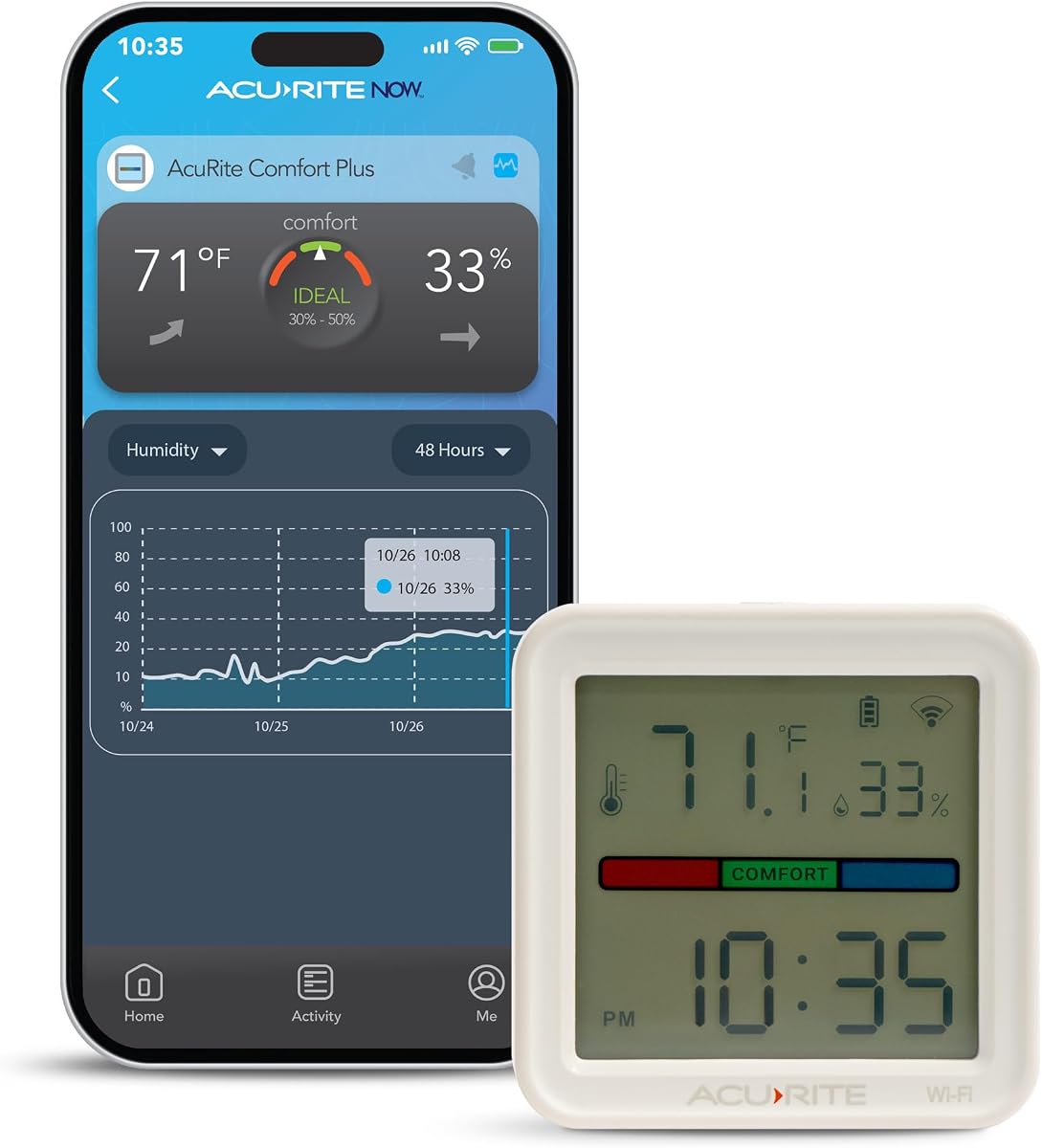
This meter offers a straightforward approach to climate monitoring. It connects to your home network to share data with the AcuRite NOW app. The screen includes a clock to keep your space organized.
We may earn a commission when you buy through this link, at no additional cost to you.
Updates occur every five minutes to ensure data is current. The keyhole hanger makes wall mounting simple. A backlight button allows for easy reading during nighttime checks.
Advanced graphing features are not included in this model. However, it covers the essentials of temperature and humidity effectively. The interface remains accessible for all users.
Best for those wanting simplicity and reliability. The WiFi connection keeps you informed without overwhelming you with complex data or features.
Enjoy a simple setup that gets you monitoring quickly without complex configuration.
Read clear digital values even in the dark with the built-in backlight.
We may earn a commission when you buy through this link, at no additional cost to you.
This unit supports both WiFi and Bluetooth to ensure connectivity wherever needed. It updates every two seconds for real-time monitoring. The Swiss sensor ensures consistent accuracy across all readings.
We may earn a commission when you buy through this link, at no additional cost to you.
App alerts help you respond quickly to sudden changes in conditions. You can view history graphs for the last 20 days online. The lanyard loop allows you to hang it easily in any spot.
Settings for alerts are managed through Bluetooth which can be less convenient. Also, it does not support 5G networks. These are minor constraints given its versatile connectivity options.
Great for users needing flexible connection options. The widget function allows quick access on mobile devices without opening the full application.
Use WiFi for remote access or Bluetooth for quick local adjustments.
See updates every two seconds to monitor changes instantly.
We may earn a commission when you buy through this link, at no additional cost to you.
This pack includes six compact sensors to monitor multiple small areas. The gateway allows for centralized control and WiFi connectivity. You can set remote alarms to stay informed of temperature swings.
We may earn a commission when you buy through this link, at no additional cost to you.
The 2-year battery life reduces maintenance needs significantly. Trend charts show changes over the last 20 days. You can export two years of data to review long-term stability.
The small screen size limits on-device readability. Also, you must use a specific gateway model for full WiFi features. These limitations are acceptable for the bulk sensor value.
Best for covering multiple distinct locations. The combination of multiple sensors and gateway control makes it a scalable solution for larger setups.
Cover six distinct zones with one purchase to monitor every corner.
Enjoy up to two years of operation on a single battery charge.
We may earn a commission when you buy through this link, at no additional cost to you.
Selecting the right monitoring device depends on your specific needs for connectivity, accuracy, and data tracking. Consider these factors to make an informed decision.
Decide between WiFi and Bluetooth based on your need for remote access. WiFi allows you to check data from anywhere while Bluetooth requires proximity to the device.
Choose WiFi for remote monitoring and Bluetooth for simple local setups.
Look for devices with high precision sensors to ensure reliable readings. Inaccurate data can lead to poor environmental control and crop stress.
Prioritize units with proven sensor technology for consistent results.
Check how much data history the device stores and if you can export it. Long-term data helps you identify trends and adjust conditions over time.
Ensure the system supports export options for detailed analysis.
Evaluate the alert methods such as push notifications, email, or alarms. Critical changes in temperature or humidity should trigger immediate warnings.
Select a device that notifies you through preferred channels.
Consider battery life and whether the device is wired or wireless. Longer battery life reduces maintenance for units in hard-to-reach locations.
Opt for long-lasting power sources to minimize interruptions.
Ensure the screen is easy to read in your lighting conditions. Large text and backlight features help you check values quickly.
Choose a display that suits your viewing environment.
Look for compatibility with other devices in your grow room. Systems that integrate with controllers can automate climate adjustments.
Check compatibility to build a unified ecosystem.
Assess the physical size and mounting options available. Compact units with wall mounts allow flexible placement without clutter.
Pick a size that fits your space constraints.
Place your device in a location that represents the average conditions of your room. Avoid direct contact with lights or ventilation vents to prevent skewed readings.
Regularly check your batteries and replace them before they die to ensure continuous operation. For wired units, inspect cables for damage to maintain safety.
Calibrate your sensor if it drifts over time by comparing it to a reference. Reset your thresholds based on seasonal changes in environmental requirements.
Vapour pressure deficit indicates how dry the air is relative to saturation. It helps growers manage transpiration rates to optimize plant growth and prevent stress.
Yes, many models offer Bluetooth or standalone display modes. However, you lose remote access capabilities unless a gateway is added.
Sensors can drift over time so calibrate every six months. Use a reference instrument to verify accuracy before starting a new grow cycle.
Using multiple sensors helps identify hot or cold spots. Place them at different heights to get a complete picture of the environment.
Most plants thrive in 40 to 60 percent relative humidity. This range minimizes disease risk while supporting healthy transpiration and growth.
Use the companion app to download CSV files from the data section. Exporting allows you to keep permanent records outside the cloud.
Most are moisture-resistant but not fully waterproof. Keep them away from direct water sprays to extend lifespan.
Some integrate with controllers to automate lights. Check compatibility before purchasing to ensure it works with your existing setup.
We reviewed ten top solutions ranging from budget-friendly options to advanced systems with multiple sensors. Pulse One led as the editor choice while Govee models offered great value.
Prioritize features that match your scale. Larger setups benefit from WiFi and multiple sensors while small rooms may only need basic Bluetooth units.
Verify current prices and availability on retailer sites. Prices change frequently so ensure you have the latest information before finalizing your purchase.