
ESP8266 ESP-01S
4.4Editor score
Compact Serial Transceiver Module
4MB Flash Memory Storage
Low Cost for Prototyping
This guide compares the top Arduino WiFi Module options for 2026, evaluating connectivity, performance, and features to help you choose the right board for
Finding the right Arduino WiFi Module is essential for modern IoT projects. Whether you need simple connectivity or advanced dual-core processing, the right board ensures reliable performance and seamless integration into your smart devices.
We evaluated ten top-rated modules based on wireless capabilities, processing power, and ease of use. Our comparison covers everything from classic ESP8266 transceivers to the latest UNO R4 WiFi boards for diverse applications.
Each pick highlights specific strengths for different project needs. Prices and availability change frequently, so verify current listings before purchasing to ensure you get the best value for your specific development requirements.
4.4Editor score

4.7Editor score

4.5Editor score
The following table provides a side-by-side comparison of all ten selected modules. Review the key specifications to quickly identify which board aligns best with your specific project requirements and budget constraints.



The Arduino UNO R4 WiFi stands out as the top choice for advanced projects requiring robust connectivity and processing power. With a 4.7 rating from users, it delivers exceptional performance for IoT and embedded applications needing modern features.
We may earn a commission when you buy through this link, at no additional cost to you.
Its dual-core architecture combines the Renesas RA4M1 and ESP32-S3 chips, allowing high-speed communications and real-time data processing simultaneously. The built-in Wi-Fi and Bluetooth 5.0 ensure reliable connections without extra modules.
While the higher price reflects its premium capabilities, the included LED matrix and CAN support justify the cost for professional or complex hobbyist projects. It balances performance with ease of use effectively.
Developers looking for a future-proof board with integrated wireless capabilities should choose this model. It is ideal for those who need versatile I/O options and robust cloud connectivity in a single package.
The combination of ARM Cortex-M4 and ESP32-S3 allows simultaneous processing of control logic and wireless tasks without performance degradation.
The built-in 12×8 LED matrix provides immediate visual status updates without requiring external display components for simple interfaces.
We may earn a commission when you buy through this link, at no additional cost to you.
The HiLetgo ESP8266 ESP-01 is a classic choice for developers needing basic wireless connectivity. Rated 4.2 by users, it offers a reliable way to add Wi-Fi to projects using standard serial communication.
We may earn a commission when you buy through this link, at no additional cost to you.
It supports three operating modes including AP and STA, allowing flexible network configurations. The ESP8266 chip provides sufficient on-board processing for simple tasks like sensor data transmission.
While it lacks a USB interface and requires careful voltage handling, its low cost and small size make it ideal for space-constrained prototyping. Users appreciate the simplicity of setup.
This module is perfect for those building multiple units or needing basic IoT connectivity. It remains a popular choice for cost-effective projects where size and price are primary concerns.
Support for AP and STA modes allows the module to act as both a client and an access point for various networking scenarios.
Using standard serial commands simplifies integration with microcontrollers that support UART communication without complex drivers.
We may earn a commission when you buy through this link, at no additional cost to you.
The ESP8266 ESP-01S offers excellent value with its increased 4MB flash memory and improved signal strength. It maintains a 4.4 rating for reliable performance in standard IoT applications.
We may earn a commission when you buy through this link, at no additional cost to you.
This latest version of the module is easier to configure in Arduino IDE as a generic board. The additional memory supports more complex sketches and data logging capabilities.
It requires careful attention to power voltage levels and soldering, but the performance benefits outweigh these small setup challenges. Users value the signal stability in various environments.
Ideal for budget-conscious makers, this module provides the best balance of cost and capability. It is a solid starting point for anyone learning wireless development.
The 4MB flash allows for larger programs and local data storage without needing external memory chips.
The updated antenna design provides stronger wireless connectivity compared to older ESP-01 versions.
We may earn a commission when you buy through this link, at no additional cost to you.
Aitrip offers a 5-pack solution for developers needing multiple units for distributed sensor networks. Rated 4.4, these modules provide consistent performance for standard wireless tasks.
We may earn a commission when you buy through this link, at no additional cost to you.
The modules support standard AP and STA modes and work well with NodeMCU environments. They are designed for industrial and smart grid applications requiring reliable transmission.
The 1MB flash is sufficient for basic code but limits complex data storage. Proper voltage regulation is essential to avoid damage during operation.
This pack is perfect for scaling projects without significant cost increases. Users appreciate the reliability and the flexibility of having multiple modules available.
Designed for smart grids and industrial control, these modules ensure stable performance in demanding environments.
The 5-pack allows for building multiple devices simultaneously without waiting for additional shipments.
We may earn a commission when you buy through this link, at no additional cost to you.
ELEGOO provides a high-performance ESP32 solution with 3 boards for versatile development. Rated 4.7, it offers dual-core processing up to 240 MHz for complex tasks.
We may earn a commission when you buy through this link, at no additional cost to you.
It features Bluetooth 4.2 and Wi-Fi for comprehensive connectivity. The USB-C port simplifies power and programming, while OTA support allows remote firmware updates.
Battery-powered devices benefit from dynamic clock scaling and low-power modes. The 3-pack ensures you have spares for prototyping and testing phases.
This board is excellent for developers needing high speed and multiple connectivity options. It balances cost and performance well for advanced IoT applications.
Processing logic and wireless tasks on separate cores improves overall system responsiveness and stability.
OTA support means you can update devices in the field without physical reconnection.
We may earn a commission when you buy through this link, at no additional cost to you.
The Arduino Nano ESP32 brings premium features to a compact form factor. Rated 4.5, it utilizes the ESP32-S3 chip for high-performance edge machine learning tasks.
We may earn a commission when you buy through this link, at no additional cost to you.
It supports Human Interface Device profiles, enabling custom keyboards or mice. MicroPython compatibility allows rapid prototyping using Python code for easier development.
While headers are not included, the design is perfect for modern production stages. The stable wireless connectivity ensures reliable long-distance data transfer.
This board is ideal for innovative projects requiring custom inputs or Python development. It represents the cutting edge of Arduino-based wireless capabilities.
HID support transforms the board into a virtual keyboard or mouse for unique input solutions.
MicroPython compatibility lowers the barrier to entry for developers familiar with Python syntax.
We may earn a commission when you buy through this link, at no additional cost to you.
This pack of four ESP8266 ESP-01S modules provides reliable components for building multiple devices. Rated 4.4, they are self-calibrated for optimal performance.
We may earn a commission when you buy through this link, at no additional cost to you.
The modules are designed with reusable materials and are suitable for wearable electronics or sensor networks. Their small form factor aids in compact designs.
While they are standard transceivers, the bulk pack offers cost efficiency for larger projects. Users appreciate the durability and consistent wireless range.
Perfect for teams or individuals needing several units, this set ensures consistent quality across devices. It is a solid choice for scalable projects.
Factory calibration ensures optimal signal transmission and reception without manual tuning.
The small footprint makes these ideal for integration into clothing or wearable smart devices.
We may earn a commission when you buy through this link, at no additional cost to you.
This 5-pack of ESP-01S modules offers substantial value with 4MB flash memory per unit. Rated 4.5, they ensure sufficient space for data logging and larger applications.
We may earn a commission when you buy through this link, at no additional cost to you.
The DOUT protocol mode simplifies configuration during programming. Users note the reliable connectivity and straightforward integration with Arduino IDE.
Strict voltage limits must be observed to avoid hardware failure. However, the performance stability makes this pack a reliable choice for bulk deployments.
Ideal for developers needing multiple high-memory modules, this bundle is cost-effective. It supports robust IoT applications requiring local storage.
4MB flash per module supports extensive data logging without external memory expansion.
DOUT protocol ensures compatible SPI programming modes for smooth software uploads.
We may earn a commission when you buy through this link, at no additional cost to you.
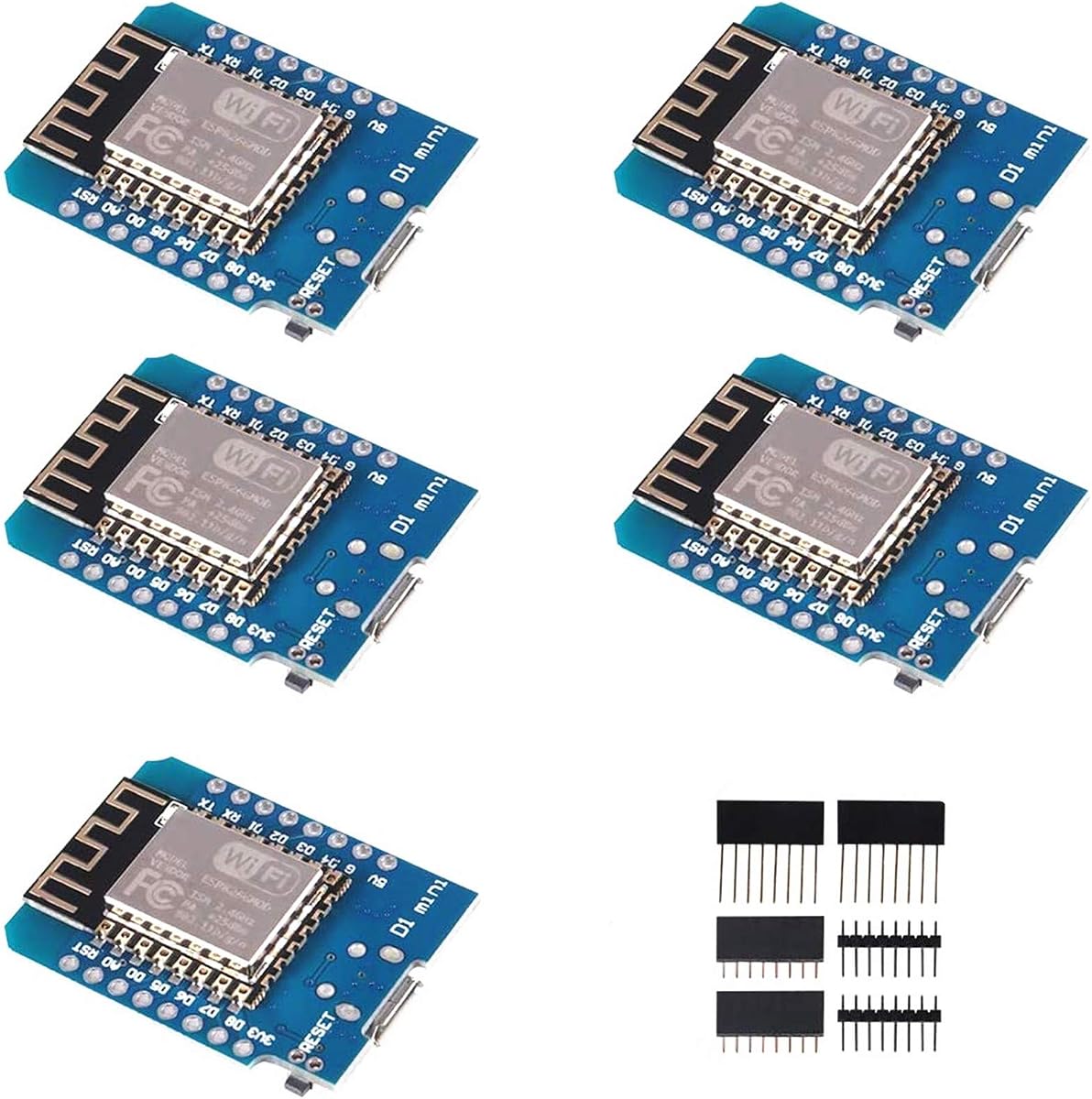
This D1 mini board provides more I/O pins than standard ESP-01 modules, Rated 4.5, it offers a convenient NodeMcu alternative with onboard power supply.
We may earn a commission when you buy through this link, at no additional cost to you.
It features Micro USB for easy connection and supports Arduino IDE programming. The 4M bytes of flash allow for complex sketches and data handling.
While Micro USB is becoming less common, the additional pins are a significant advantage for complex wiring needs. The board integrates power management effectively.
Perfect for projects needing more connections, this board is a versatile alternative to raw modules. It simplifies prototyping with built-in interfaces.
11 digital I/O pins enable control of multiple sensors and actuators without extra expansion boards.
A 5V 1A switching power supply on the board ensures stable power for connected components.
We may earn a commission when you buy through this link, at no additional cost to you.
This 10-pack ensures you have ample modules for large-scale deployment. With a perfect 5.0 rating, users report exceptional reliability and consistent performance.
We may earn a commission when you buy through this link, at no additional cost to you.
The LWIP protocol support simplifies network stacks for Arduino users. All standard modes including AP and STA are available for flexible configurations.
The only drawback is the basic interface which requires external adapters for some uses. However, the reliability and quantity make it unbeatable for bulk needs.
Ideal for enterprises or large hobbyist groups, this pack provides cost-effective connectivity. It is the best choice for ensuring supply chain stability.
Built-in LWIP simplifies TCP/IP stack implementation for seamless internet connectivity.
Ten modules ensure sufficient quantity for large projects without recurring reorders.
We may earn a commission when you buy through this link, at no additional cost to you.
Selecting the right module depends on your specific project needs regarding processing power, connectivity range, and ease of use.
Different modules offer varying connectivity options such as Wi-Fi only or dual-band Wi-Fi with Bluetooth. Consider if you need to connect to local networks, the internet, or other devices directly. Bluetooth is useful for short-range communication and device pairing without internet dependency.
Choose modules that support both Wi-Fi and Bluetooth if you need versatile connectivity for home automation or sensor networks.
Modules range from simple ESP8266 chips to advanced dual-core ESP32 processors. Higher processing power enables complex algorithms, data processing, and running multiple tasks simultaneously. Consider your code complexity and data handling requirements when selecting a chip.
For complex tasks involving data analysis or AI, opt for dual-core solutions like the ESP32 or UNO R4.
Flash memory varies from 1MB to 4MB or more. More storage is necessary for large programs, data logging, or saving network credentials securely. Check the specifications to ensure the memory fits your application needs.
Prioritize modules with at least 4MB flash if you plan to store data locally or run complex libraries.
Most Wi-Fi modules require 3.3V power. Using 5V directly can damage the component. Ensure your power supply or board is regulated properly to avoid hardware failure during operation.
Always verify voltage levels before connecting and use level shifters if needed.
Some modules require serial communication and external USB to TTL converters. Others come with USB-C or USB interfaces built-in. Integrated interfaces simplify prototyping and reduce wiring complexity significantly.
Select boards with USB-C or integrated USB for easier connection and power supply.
Look for built-in features like LED matrices, DACs, or CAN support. These additions reduce the need for external components and simplify project design. They are valuable for visual feedback and industrial applications.
Choose modules with integrated peripherals if you need visual indicators or industrial bus support.
Check if the module is compatible with Arduino IDE, MicroPython, or other preferred environments. Community support and documentation quality influence the ease of development and troubleshooting significantly.
Prefer modules with extensive community support and compatible libraries for smoother development.
Bulk packs often offer better value for large projects. Compare price per unit to ensure you get the best deal for your quantity needs without paying for unnecessary extras.
Buy multi-packs if you plan to deploy multiple devices to save on total costs.
Connect the module to your computer using a USB cable or a serial adapter depending on the specific interface of the board. Install the necessary drivers and select the correct board and port within the Arduino IDE settings.
Upload your code by clicking the upload button and monitor the serial monitor for connection status. Ensure your Wi-Fi credentials are entered correctly in the sketch to establish a network connection.
Protect your module from static electricity and excess heat by avoiding direct sunlight or high temperatures. Use heat sinks if the board operates continuously under heavy processing loads to prevent overheating.
Not always. Some boards like the Arduino UNO R4 WiFi have Wi-Fi built-in. However, standard boards usually require an external ESP8266 or ESP32 module to access wireless networks.
Yes, most of these modules are compatible with the Arduino IDE. You can write standard sketches and upload them directly to the board for control and sensor reading.
Most ESP modules run at 3.3V. Direct connection to 5V power sources can damage the unit. Ensure your power supply or voltage regulator provides stable 3.3V output.
The Arduino UNO R4 WiFi or Nano ESP32 are excellent for beginners due to integrated Wi-Fi and easy USB connections. They simplify setup compared to raw modules.
Many modern modules like the ESP32 and UNO R4 support Bluetooth alongside Wi-Fi. This allows for device pairing and short-range communication without internet access.
Over-the-Air (OTA) updates are supported by many ESP32 and UNO R4 boards. This allows you to push code changes via Wi-Fi without physical connection.
The Arduino UNO R4 WiFi stands out as the top overall choice for advanced projects requiring integrated connectivity and processing power. For budget-conscious users, the ESP8266 ESP-01S offers excellent value and performance.
When prioritizing, consider your specific needs such as processing speed, memory size, and interface preferences. Choosing the right board now ensures smoother development and long-term reliability.
Verify current availability and pricing before purchasing as these factors fluctuate frequently. Investing in a reliable module will save time and effort on future projects and repairs.