
Universal Power Supply Module
4.6Editor score
Fits MB102 breadboards
3.3V and 5V outputs
Compact and reliable design
This guide compares the top 12V Breadboard Power Supply models for prototyping. We review features, compatibility, and safety to help makers choose the right
Prototyping electronics requires reliable power delivery to ensure your circuits function correctly without interruption. A quality 12V Breadboard Power Supply provides stable voltage rails that protect sensitive components like microcontrollers and sensors from damage during testing phases.
We analyzed ten top-rated power modules based on user feedback, technical specifications, and real-world usability. Each product was evaluated for voltage flexibility, current output, and ease of integration with standard solderless breadboards used by hobbyists and professionals.
Every pick in this list highlights specific strengths such as dual-channel control or universal input options. Keep in mind that product availability and pricing fluctuate frequently so verify current details before finalizing your purchase decision for your workspace.
4.6Editor score

4.5Editor score

4.5Editor score
This side-by-side comparison outlines the core specifications and key capabilities of each featured power module. Review these details to understand how each unit handles voltage regulation and current demands for your specific electronics projects.




This dual-module pack stands out as a top choice for modern prototyping needs due to its versatile input options and independent channel control. The inclusion of both USB-C and classic DC inputs means you can power your board using standard phone chargers or adapters without hunting for obsolete cables. It receives high marks for reliability and ease of use in busy workshop environments.
We may earn a commission when you buy through this link, at no additional cost to you.
The standout feature is the ability to run different voltages on the left and right rails simultaneously. You can switch one side to 3.3V for logic circuits while keeping the other at 5V for peripherals like motors or relays. This flexibility eliminates the need for multiple power supplies and simplifies wiring for complex Arduino or Raspberry Pi projects.
While the current output is sufficient for most low-power sensors and microcontrollers, users should be aware of the 700mA limit per rail. The onboard protection is a critical addition that cuts power during shorts to prevent damage to expensive components. This safety feature makes it a responsible choice for students and hobbyists who may occasionally make wiring mistakes.
We recommend this module for anyone who values versatility and safety in their electronics setup. Whether you are running a single workstation or need backups for multiple projects the two-pack offers great value. It strikes an excellent balance between modern connectivity and traditional breadboard compatibility ensuring your projects stay powered safely.
The USB-C input allows users to leverage existing phone chargers and power banks for portable prototyping anywhere without needing specialized hardware adapters.
Separate switches and voltage toggles for each channel allow precise power management enabling different voltage requirements on a single breadboard setup efficiently.
We may earn a commission when you buy through this link, at no additional cost to you.
This bundle offers exceptional value for educators or makers who need multiple power stations without spending a fortune. Each module supports the standard 6.5V to 12V input range and delivers stable 3.3V or 5V outputs suitable for general logic and microcontroller testing. It is a straightforward solution for filling a classroom or shared makerspace with reliable power sources.
We may earn a commission when you buy through this link, at no additional cost to you.
The inclusion of five 9V battery connectors adds immediate convenience for those who prefer battery-powered prototyping on the go. Users simply snap the connector onto the module input and place a standard battery on top to complete the circuit. This feature makes it ideal for portable projects or demonstrations where wall power is unavailable.
While it lacks independent channel control found in higher-end models the design keeps things simple for basic experiments. The current limit is typical for this class of regulator so avoid drawing more than 700mA to prevent overheating. The price-to-performance ratio makes it a smart choice for large scale distribution where advanced features are less critical.
We recommend this kit for schools or groups needing several power supplies for collaborative learning. It provides a functional entry point into breadboard power distribution without complexity. For users requiring more current or separate rails this model still serves well as a backup or primary supply for smaller circuits.
Included 9V battery connectors enable quick transition to portable power allowing students to test circuits anywhere without access to mains electricity.
Packaging five modules together reduces per-unit cost significantly making it an accessible option for bulk purchases in educational environments.
We may earn a commission when you buy through this link, at no additional cost to you.
This kit is designed as an all-in-one solution for beginners who need everything to start building circuits immediately. It includes a standard 830-point breadboard and a compatible power module so users do not need to source components separately. The included 12V adapter ensures the power supply can run right out of the box.
We may earn a commission when you buy through this link, at no additional cost to you.
The package comes with 65 colorful jumper wires which are essential for connecting the power module to your board. This convenience saves time and ensures you have the necessary tools to prototype quickly. The breadboard size is standard for most hobbyist projects allowing plenty of space for larger designs.
While the power module follows standard specifications without advanced features it covers the basic needs of most entry-level projects. The adapter provides stable input but users should monitor current draw to stay within safe limits. It is a practical option for those who want a single purchase to cover initial prototyping needs without multiple shipments.
We suggest this kit for first-time users or classroom setups requiring complete sets. It eliminates the friction of buying parts individually and ensures compatibility between board and power source. For seasoned engineers it may lack advanced features but for starters it provides a solid foundation for learning electronics basics.
The inclusion of board module and power adapter means users can begin experimenting immediately upon receiving the package without additional purchases.
Colorful jumper wires included simplify connections and reduce clutter helping beginners visualize circuit layouts and wire paths clearly.
We may earn a commission when you buy through this link, at no additional cost to you.
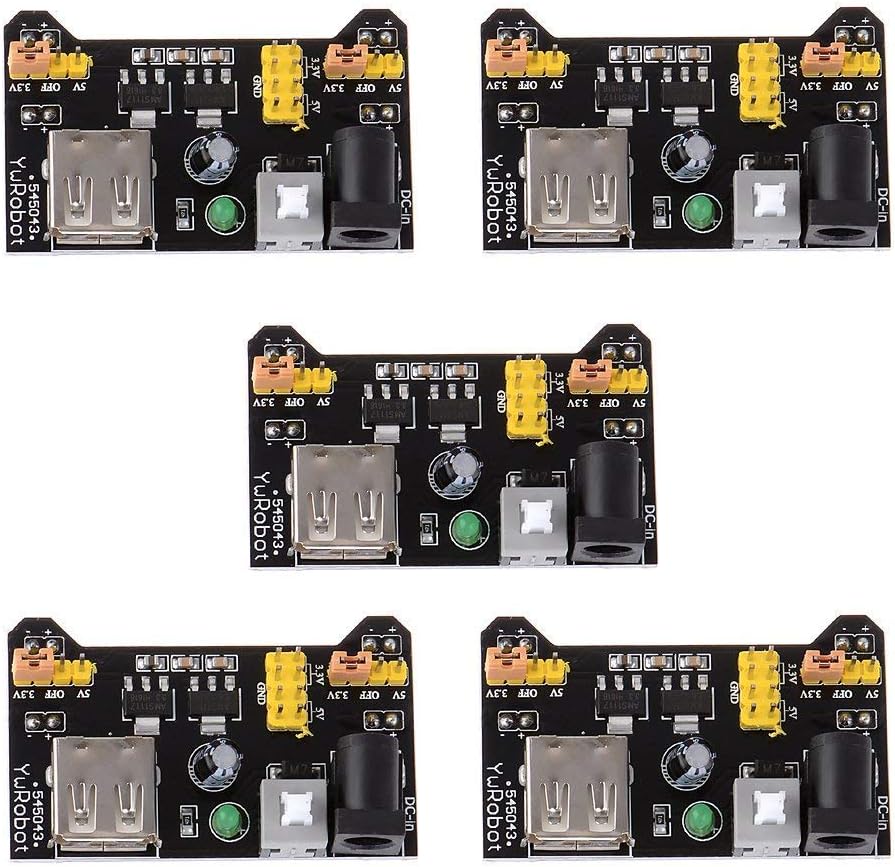
This pack provides five modules that fit standard MB102 breadboards making it a convenient option for maintaining multiple workstations. Each unit offers selectable 3.3V and 5V outputs via onboard jumpers to suit different component requirements. The design is minimal and functional focusing on delivering stable power without unnecessary extras.
We may earn a commission when you buy through this link, at no additional cost to you.
Users should note the input range is limited to 6.5V to 9V which differs from some other models accepting up to 12V. This means you must ensure your power adapter matches this requirement to avoid performance issues. Despite this the module performs well for low power projects like LED matrices or small sensor arrays.
The straightforward design reduces points of failure which can be beneficial for basic prototyping tasks. There is no USB input so you will need a DC wall adapter for power. For hobbyists who prefer simplicity and standard specs this module remains a reliable choice for powering logic circuits consistently.
We recommend this module for users with existing power supplies that match the input range. It is cost-effective for bulk needs and provides stable voltage for general electronics work. While it lacks modern input features it delivers consistent performance for traditional DC powered setups.
The fixed output rails ensure stable power for digital logic making it suitable for Arduino and similar microcontroller projects without voltage fluctuations.
Small footprint allows efficient use of board space leaving more room for components and wiring without cluttering the workspace.
We may earn a commission when you buy through this link, at no additional cost to you.
This module earns high praise for its reliability and compatibility with a wide range of modern microcontrollers. It accepts input from 6.5V to 12V via DC jack or USB offering flexibility depending on your workspace setup. The 3.3V and 5V outputs are stable ensuring your ESP32 or Raspberry Pi projects run smoothly without brownouts.
We may earn a commission when you buy through this link, at no additional cost to you.
Users appreciate the direct plug-in design that integrates seamlessly into MB102 breadboards without extra wiring. The compact size keeps your workspace organized while delivering sufficient power for most hobbyist projects. Its high rating reflects consistent performance in real-world tests by makers and engineers.
While it provides essential features it does not offer advanced protections like over-current limiting found in higher-end models. This means users should be careful not to exceed the rated current limits. However for general prototyping it provides a solid balance of convenience and stability.
We recommend this module for those who need a reliable power source for various electronics projects. It is an excellent choice for users who value versatility and compatibility. Whether you are working on IoT devices or simple circuits it delivers steady power when you need it most.
Support for both DC and USB input lets users adapt to available power sources whether using wall adapters or portable battery packs.
Small form factor and efficient regulation minimize power waste keeping your workspace cool and saving energy during extended testing sessions.
We may earn a commission when you buy through this link, at no additional cost to you.
This pack offers a practical solution for users needing multiple power supplies with added convenience features like status LEDs. Each module displays power status via a green LED allowing quick visual checks during testing. The included 9V connectors make battery operation straightforward without needing extra adapters.
We may earn a commission when you buy through this link, at no additional cost to you.
The self-locking switch provides clear on-off control preventing accidental power drain when the board is not in use. Users can select voltage output via a jumper to suit their circuit needs. The regulated output ensures stability across the input range which is vital for consistent project performance.
While it does not offer dual independent rails the simple design reduces complexity for beginners. The current limit is standard for this category so plan your circuit accordingly. The value of having five modules plus connectors makes it a strong option for workshops or labs.
We suggest this bundle for teams or students requiring reliable and simple power sources. The visual indicators and battery support add practical value that enhances the prototyping experience. It remains a solid choice for general use where advanced features are less prioritized than convenience and quantity.
Green LED indicators provide instant feedback on power state helping users troubleshoot issues without needing external multimeters.
Included connectors simplify battery powered setups enabling portable projects without complex wiring or custom adapters.
We may earn a commission when you buy through this link, at no additional cost to you.
This kit stands out by offering adjustable output alongside fixed rails for a versatile prototyping experience. The digital display provides real-time voltage feedback helping users fine-tune settings accurately. It is particularly useful for projects requiring voltages outside standard 3.3V or 5V ranges.
We may earn a commission when you buy through this link, at no additional cost to you.
The LM2596 regulator supports higher voltage outputs up to 12V making it suitable for more demanding applications. However the assembly requires soldering which may deter absolute beginners. Once built it provides a robust power center for labs needing varied power levels.
Users should be aware of the added complexity compared to plug-and-play modules. The soldering process ensures better electrical connection but adds time to setup. For those comfortable with basic soldering the flexibility makes it a valuable asset in a workshop.
We recommend this for makers who need custom voltage levels without separate supplies. It bridges the gap between fixed modules and benchtop power supplies. While assembly is required the payoff in versatility justifies the effort for advanced hobbyists.
The built-in digital display allows precise monitoring ensuring your circuit receives exactly the voltage you set without guesswork.
Having fixed outputs plus an adjustable channel provides options for different components on one board reducing clutter and connections.
We may earn a commission when you buy through this link, at no additional cost to you.
This module distinguishes itself with higher current capabilities compared to standard breadboard power supplies. It delivers 1.5A at 5V and 1A at 3.3V ensuring sufficient power for motor drivers or larger sensor arrays. The independent channel control allows precise management of voltage rails for complex setups.
We may earn a commission when you buy through this link, at no additional cost to you.
An integrated USB output adds extra convenience for powering USB devices directly from the breadboard setup. The compact size saves space while maintaining robust performance. Users appreciate the stability and reliability which reduce dropout risks during intensive testing.
While it carries a higher price the extra current headroom justifies the cost for demanding projects. It is a premium option for those who need more than basic power for sensors. The design balances performance with portability making it a strong choice for serious hobbyists.
We recommend this module for users with higher current needs like robotics or IoT nodes. It offers premium features in a compact package ideal for advanced prototyping. For standard logic projects it is robust and reliable ensuring your components get the power they need.
Increased current limits allow powering high draw devices without requiring external regulators or separate power adapters for your setup.
USB output ports enable direct powering of USB peripherals simplifying connections for cameras or wireless modules on the same board.
We may earn a commission when you buy through this link, at no additional cost to you.
This switching module offers a wide input range up to 40V making it highly versatile for various power sources. It includes fixed outputs plus an adjustable channel allowing users to tailor voltage precisely for specific components. The high efficiency means less heat generation compared to linear regulators.
We may earn a commission when you buy through this link, at no additional cost to you.
Users should note it is not a direct breadboard plug-in so wiring is required to connect to your rails. This adds a small step but provides more flexibility in installation. The rating reflects consistent performance and stability in diverse electrical environments.
It is best suited for users who already have a wiring setup or need high input tolerance. The adjustable output is useful for prototyping circuits with varying voltage needs. While it lacks plug-in convenience the performance and versatility are strong selling points for advanced users.
We suggest this module for those needing flexibility beyond standard inputs. It is ideal for projects requiring specific custom voltages or high voltage inputs. For those comfortable with wiring it provides a powerful and efficient power solution.
Switching technology minimizes heat production improving efficiency and extending component life during long testing runs.
Accepting voltages up to 40V ensures compatibility with many adapters and batteries reducing need for extra regulation.
We may earn a commission when you buy through this link, at no additional cost to you.
This universal adapter provides a broad voltage range from 3V to 24V with substantial current for diverse projects. The LCD display shows output voltage clearly helping you set exact levels without a multimeter. It includes many tip options making it a versatile power source for different device needs.
We may earn a commission when you buy through this link, at no additional cost to you.
While not designed specifically for breadboards the alligator clip cable allows connection to bare wires or board rails. This flexibility supports larger prototypes needing higher power than standard modules. Safety features protect against shorts and overloads ensuring reliable operation.
It is ideal for users who need a central power source for many types of electronics beyond breadboards. The current capacity supports motor drivers and LEDs efficiently. For pure breadboard use it requires a bit more setup but offers unmatched flexibility and control.
We recommend this for those wanting one power source for all projects. It is a powerful option for workshops with varied requirements. While it is not plug-and-play for breadboards its capabilities make it a valuable addition for complex testing.
LCD display allows exact voltage selection reducing trial and error and preventing damage from incorrect settings during prototyping.
Included tips cover a wide range of devices making it a practical universal power solution for entire workbench needs.
We may earn a commission when you buy through this link, at no additional cost to you.
Selecting the right power module ensures your circuits receive stable voltage and current without risking damage. Here are key factors to consider before making your purchase.
Most breadboard power supplies provide 3.3V and 5V rails to cover the majority of microcontroller needs. Check if your module supports independent switching for each rail to run mixed logic levels. Some models offer adjustable outputs for custom projects requiring non-standard voltages.
Always confirm the output matches your components requirements to prevent under-voltage or over-voltage damage.
Modules typically accept 6.5V to 12V DC input or USB power. A wider range gives you flexibility to use various adapters or battery packs. Ensure your wall adapter matches the module input to avoid startup issues.
Choose a unit with an input range compatible with your existing power setup for best results.
Standard modules supply up to 700mA per rail which suits most sensors and logic. For motors or high-power devices look for units offering 1A or more. Exceeding rated current can cause overheating and instability.
Calculate total current draw of all components to ensure the supply can handle the load.
Most modules plug directly into standard MB102 breadboards for quick setup. Verify the pin layout matches your board to prevent fit issues. Some kits include adapters or extenders for compatibility.
Prioritize modules that fit your breadboard without additional wiring for convenience.
Built-in over-current and short-circuit protection safeguard your projects from accidental wiring mistakes. This feature is essential when working with expensive components like microcontrollers. Look for modules with thermal shutdown as well.
Safety features are worth the extra cost to prevent damage to your hardware.
Modern modules often include USB-C or standard USB inputs for portable use. This allows you to power projects with power banks or laptops easily. Traditional DC inputs offer higher voltage tolerance for robust setups.
Select input types that match your work environment and power source availability.
LED status lights help you quickly verify if power is active without multimeters. Separate indicators for each channel are helpful for debugging circuits. Some units include displays for precise voltage monitoring.
Visual feedback saves time during troubleshooting and improves workflow efficiency.
Buying in packs can reduce per-unit cost for teams or classrooms. Consider whether you need extras for backup or shared workstations. Single premium units may offer better features but cost more.
Balance the number of units against the feature set for best value.
Begin by inserting the module into the power rails of your breadboard ensuring the pins align correctly with the bus bars. Check that the voltage selector switches are set to the correct output for your project components before powering on.
Connect your power adapter to the input jack and turn on the switch. Monitor the LED indicators to confirm power is active. Use jumper wires to connect the rails to your circuit components ensuring correct polarity.
To maintain longevity avoid drawing current above the rated limit which may overheat the module. Keep the unit clean and free of dust to ensure proper airflow. Store in a dry place when not in use to protect internal electronics.
The 3.3V rail powers low-voltage logic like modern microcontrollers while 5V suits older chips and peripheral devices. You need both to run mixed circuits without risking component damage from incorrect voltage.
Yes if your module supports USB input. Many modern units accept USB-C or micro-USB allowing portable power. Ensure your bank provides sufficient current to meet your circuit needs without draining quickly.
Overheating usually occurs when drawing too much current for the module rating. Check your connected components total draw and reduce load or upgrade to a higher-current supply to prevent thermal shutdown.
Most standard modules are plug-and-play and require no soldering. They slot directly into breadboards. However some adjustable kits might require soldering for permanent setups. Check the product description before buying.
Input voltage depends on the specific module specs. Most accept 6.5V to 12V DC. Using a voltage higher than specified may damage the module so verify limits with your power source before connecting.
It is possible with extensions but current draw adds up quickly. For stable power use separate modules for each board when possible. This prevents voltage drops and keeps circuits isolated from interference.
We have reviewed ten top power modules that cater to different prototyping needs and budgets. From versatile dual-channel packs to high-current units there is a solution for every maker looking to streamline their power distribution.
Prioritize models with robust protection features and compatible inputs to ensure safety and convenience. Consider your typical project current requirements to avoid overloading standard regulators during extended testing sessions.
Prices and stock levels change often so double-check availability before purchasing. Verify the latest specs to match your workspace needs as new models may become available.