
EinScan Rigil
4.9Editor score
Wireless all-in-one design
Hybrid blue laser and IR
High-performance onboard computing
This guide compares the top 3D scanners for reverse engineering, evaluating precision, speed, and workflow features for industrial design and prototyping.
Reverse engineering demands high precision tools to capture exact dimensions of physical objects. A good 3D scanner for reverse engineering must deliver micron-level accuracy while handling complex geometries and diverse materials with ease. Professionals rely on these devices to bridge the gap between physical parts and digital CAD models efficiently.
We compared ten top-rated scanners based on their scanning modes, accuracy specifications, and software integration capabilities. Our analysis focuses on devices that excel in industrial applications, ensuring they can handle everything from small mechanical parts to large automotive components without compromising data integrity or workflow speed.
Each pick in this list highlights unique strengths tailored to specific engineering needs, whether you prioritize portability or extreme precision. Note that product availability and specifications can change over time, so always verify current details before purchasing to ensure the device meets your specific project requirements accurately.
4.9Editor score

4.8Editor score

4.5Editor score
This comparison table provides a side-by-side overview of the ten selected scanners, highlighting their key specifications and unique capabilities to help you make an informed decision for your reverse engineering projects.



The Revopoint MetroX Pro stands out as a top-tier solution for reverse engineering professionals requiring high precision. It offers industrial-grade blue laser scanning that captures every detail with up to 0.01 mm single-frame precision. This makes it ideal for detailed modeling and industrial measurement tasks.
We may earn a commission when you buy through this link, at no additional cost to you.
Its advanced scanning modes, including 30 cross-line lasers and 15 parallel lines, allow it to handle shiny or dark surfaces effortlessly without spray. The ability to stream scans to mobile devices in real time enhances workflow efficiency by allowing flexible positioning. The Revo Metro software provides intuitive tools for editing and merging data seamlessly.
While the Revo Design software is sold separately, the included Revo Metro tools cover most essential needs. The device relies on a PC connection for full functionality which may limit portability compared to standalone units. However, its high speed of up to 7 million points per second offsets this for most stationary setups.
This scanner is best for users who need precision and speed in a controlled environment. It is particularly useful for industrial inspection and creative design where accuracy is paramount. Professionals looking to reverse engineer complex parts will find its features highly capable and reliable for daily use.
The MetroX Pro uses blue laser technology to capture intricate details with up to 0.01 mm single-frame precision. This level of accuracy ensures that every dimension is faithfully represented in the digital model for engineering tasks.
Users can stream scans directly to phones or tablets via the Revo Mirror app allowing them to move freely. This feature improves workflow efficiency by removing the need to hold a laptop during scanning sessions.
We may earn a commission when you buy through this link, at no additional cost to you.
The Revopoint MetroY Ultra is designed for users who need maximum speed without sacrificing precision. It delivers up to 90 FPS scanning speeds with an NVIDIA GPU enabling rapid data acquisition for large objects. Its industrial-grade accuracy with up to 0.01 mm single-frame precision ensures reliable results for reverse engineering.
We may earn a commission when you buy through this link, at no additional cost to you.
With five versatile scanning modes it handles everything from small parts to medium-sized objects efficiently. The device supports Wi-Fi 6 for wireless freedom allowing you to move away from cables during scanning. The included 5500 mAh battery grip provides about 2.5 hours of stable power for extended field work.
While the speed depends on GPU hardware the CPU performance is still robust at 60 fps. The device can scan outdoors in harsh sunlight up to 100,000 lux which adds significant versatility. However the price is higher than standard models reflecting its premium performance capabilities.
This scanner is ideal for professionals working in dynamic environments or needing high throughput. Its ability to scan without spray on dark or shiny surfaces protects delicate parts and saves prep time. For demanding industrial inspection tasks the MetroY Ultra delivers exceptional performance and reliability.
Scanning speeds reach up to 90 fps with an NVIDIA GPU reducing data acquisition time significantly. This speed boosts productivity allowing complex objects to be digitized in minutes rather than hours.
The built-in Wi-Fi 6 support breaks free from restrictive cables enhancing mobility during scans. Combined with the battery grip it enables stable power and control in environments without easy access to outlets.
We may earn a commission when you buy through this link, at no additional cost to you.
The EinScan Rigil offers a unique wireless all-in-one solution for reverse engineering with onboard computing. It features hybrid blue laser and IR VCSEL technology for ultra-precise scanning of up to 0.04 mm accuracy. This system captures vibrant textures with a 5MP camera making it ideal for automotive and design applications.
We may earn a commission when you buy through this link, at no additional cost to you.
Its triple modes include Standalone Wireless PC and Wired PC giving users flexibility in connectivity. The device has a 2.4GHz CPU with 32GB DDR5 RAM and 1TB SSD ensuring smooth and fast processing. The replaceable batteries allow you to scan on-the-go even outdoors in challenging lighting conditions.
The Rigil can scan dark and reflective surfaces with ease using its advanced IR laser algorithm. The 6.4 inch AMOLED touchscreen enhances usability directly on the device without needing a PC. However it is heavier than some handheld options due to its internal computing components.
This scanner is perfect for engineers who need a self-contained portable powerhouse. It eliminates the need for external devices during scanning which simplifies the setup process. The inclusion of one-on-one online training helps users get started quickly and effectively.
The Standalone mode allows you to scan anywhere without a PC connection or cables. This feature enhances portability making it easy to move between different workstations or sites.
Combining blue laser and IR VCSEL technology provides precise results on challenging surfaces. This ensures high fidelity data capture for detailed engineering and prototyping workflows.
We may earn a commission when you buy through this link, at no additional cost to you.
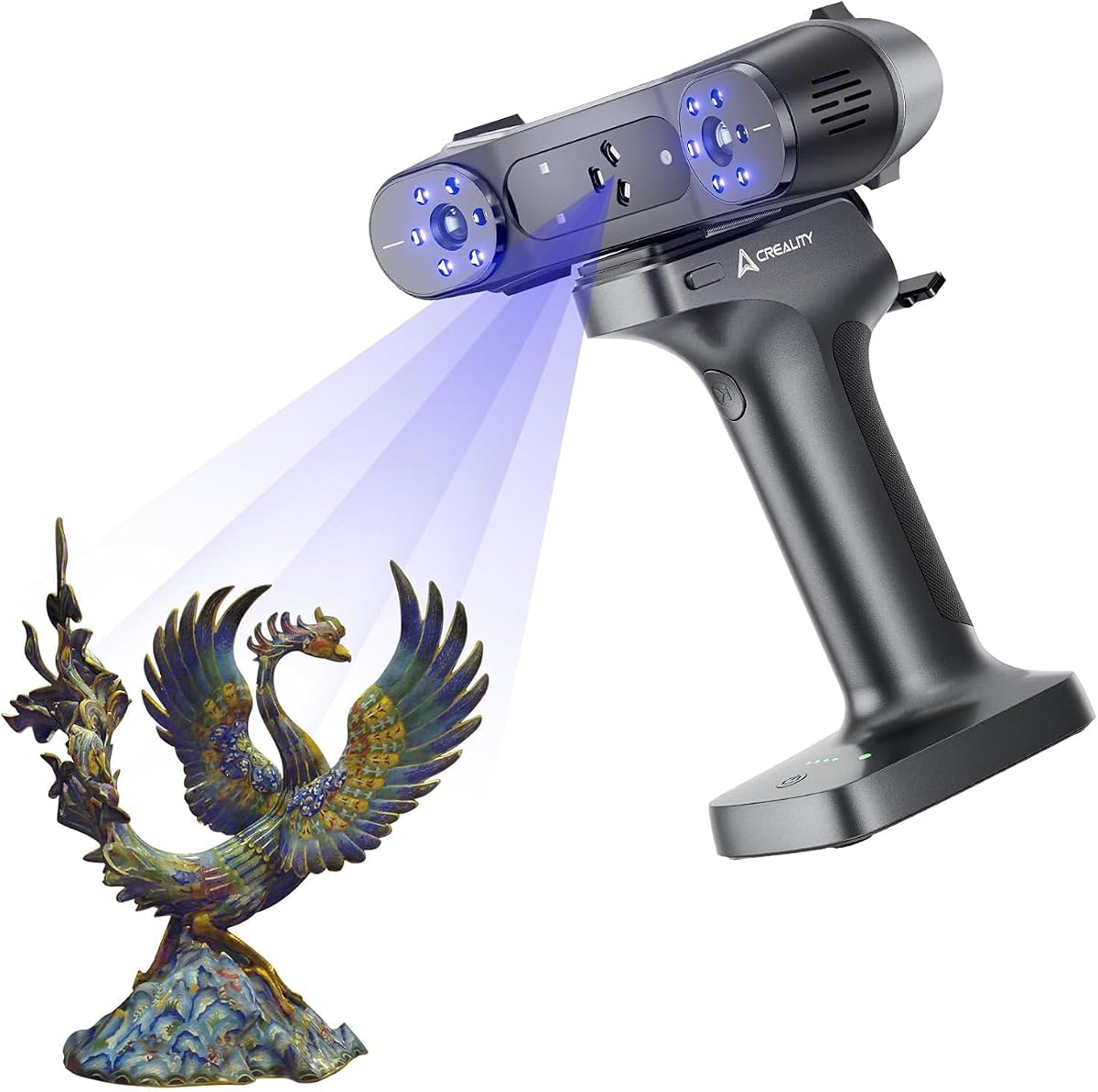
The Creality CR-Scan Raptor Pro is equipped with 22 crossed blue lasers and 7 parallel blue lasers for high-speed precision. It captures details accurately with up to 660,000 dots per second. This setup allows it to handle medium and large objects comfortably reducing the need for multiple scans.
We may earn a commission when you buy through this link, at no additional cost to you.
Its all-weather performance algorithm ensures stability in both high and low temperature environments. The scanner supports a vast range from 5mm to 4000mm making it suitable for body scanning and automotive modification. The built-in RGB camera supports 24-bit full-color texture capture restoring true colors effectively.
The device includes anti-shock algorithms to reduce scanning interruptions and provide a smooth handheld experience. Compatibility with major design software like Geomagic and SolidWorks connects it to professional workflows. However it requires specific PC configurations to run efficiently without lag.
This scanner is ideal for users working with large scale objects or complex geometries. The combination of speed and color capture makes it versatile for prototyping and design. Its ability to scan black and metal objects without powder simplifies the inspection process significantly.
The 22 crossed blue lasers cover a wide range for rapid scanning of large areas. This configuration ensures efficient data capture for medium to large industrial components.
Scanning size ranges from tiny 5mm objects to massive 4000mm items adapting to any project. This flexibility supports automotive modification and human body scanning seamlessly.
We may earn a commission when you buy through this link, at no additional cost to you.
The Revopoint INSPIRE 2 is designed for portability with a lightweight 190g build. It features wireless scanning via WiFi 6.0 enabling on-the-go operations without heavy cables. The accuracy of up to 0.05 mm makes it suitable for 3D printing and reverse engineering tasks requiring detail.
We may earn a commission when you buy through this link, at no additional cost to you.
Its dual scanning modules include infrared structured light and multi-line laser modes for different materials. The adjustable optical zoom allows users to capture every detail of mixed-geometry surfaces precisely. High-precision calibration board boosts point cloud accuracy by 75% ensuring consistent data.
The device can scan in outdoor environments with up to 20,000 lux lighting reliably. The included accessories like markers and turntable help start scanning immediately out of the box. However its outdoor range is less than high-end professional models for bright sunlight.
This scanner is great for users needing a portable and lightweight solution for field work. It offers a balance of precision and ease of use for various projects. The color texture capture makes it ideal for heritage preservation and product design applications.
Weighing only 190g the INSPIRE 2 is easy to carry and use for extended periods. This makes it perfect for field work or situations where mobility is essential.
A high-precision calibration board boosts point cloud accuracy by 75%. This ensures that models created are reliable for technical reverse engineering needs.
We may earn a commission when you buy through this link, at no additional cost to you.
The Creality Otter Lite Basic is an affordable option that achieves professional-grade accuracy of 0.05mm resolution. It supports both close-range and long-range scanning modes allowing you to capture fine details on small objects. The scanner is designed for portability weighing just 235g for easy transport.
We may earn a commission when you buy through this link, at no additional cost to you.
Equipped with RGB and infrared cameras it captures true-to-life color textures at up to 30 fps. The complete kit includes a turntable calibration board markers and carrying case for immediate use. User-friendly LED indicators guide scanning distance making it accessible for beginners.
It connects via USB 3.0 or 2.0 and is compatible with Windows and macOS. The software provides intuitive navigation and smart feedback for efficient scanning. However its speed is lower than high-end models which may limit complex industrial use.
This scanner is perfect for DIY enthusiasts and entry-level reverse engineering tasks. It offers great value with a comprehensive package ready for 3D printing workflows. The balance of precision and ease of use makes it a solid budget choice.
Support for close-range and long-range modes allows capturing objects from 20mm to 1500mm. This versatility covers a wide range of hobbyist and small business needs.
The package includes all necessary accessories like turntable and markers out of the box. This reduces setup time and allows users to start scanning immediately.
We may earn a commission when you buy through this link, at no additional cost to you.
The Revopoint MetroX Pro Standard offers industrial-grade high-precision scanning with up to 0.01 mm single-frame precision. It features four scanning modes including cross-line and parallel lines for capturing flat or dark surfaces efficiently. The device ensures volumetric accuracy suitable for precision modeling and industrial measurement.
We may earn a commission when you buy through this link, at no additional cost to you.
Auto turntable scanning automates the process with one-click using a dual-axis turntable. This mode captures color-accurate scans with an HD RGB camera adding realism to the model. Tracking modes feature marker and global marker enhance accuracy for complex shapes.
Intelligent software tools allow scanning editing and merging for a ready workflow. Scan data transfers seamlessly to other 3D software for reverse engineering and quality inspection. The device requires a PC which may limit portability compared to standalone options.
This scanner is ideal for engineers focused on precision modeling and industrial tasks. The high speed and accuracy meet needs for detailed part replication. It serves as a reliable tool for design and prototyping in a controlled environment.
Scans feature-rich objects at up to 7 million points per second for fast results. This speed improves productivity in industrial measurement and inspection workflows.
Feature marker and global marker tracking modes help capture any object shape accurately. This versatility is essential for industrial inspection and complex design projects.
We may earn a commission when you buy through this link, at no additional cost to you.
The Creality CR-Scan Raptor Pro achieves measurement-grade accuracy up to 0.02mm with advanced blue laser technology. It scans medium to large objects flawlessly capturing intricate details at up to 660,000 points/sec. This makes it perfect for automotive modification and industrial design tasks.
We may earn a commission when you buy through this link, at no additional cost to you.
No spray requirement saves prep time and protects delicate parts during inspection. It adapts to projects from tiny 5mm objects to massive 4000mm items with ease. The outdoor-ready wireless feature works flawlessly in up to 100,000 lux light.
Creative software offers step-by-step tutorials and advanced editing tools to simplify the process. It supports face and body modes for rapid human scans in minutes. The system requires a powerful PC configuration to run without performance issues.
This scanner is best for automotive professionals needing precise and durable scanning. Its ability to handle large and complex shapes without spray adds significant value. The robust software ecosystem further enhances its utility for design workflows.
Measurement-grade accuracy up to 0.02mm ensures reliable data for engineering parts. This precision supports detailed reverse engineering and inspection requirements.
Works flawlessly outdoors with wireless support removing the need for a lab. This flexibility allows scanning in any environment without compromising quality.
We may earn a commission when you buy through this link, at no additional cost to you.
The Creality Raptor X is a portable handheld scanner featuring 34 cross blue laser lines for reliable accuracy. It achieves single-frame scanning accuracy of up to 0.02mm for medium to large objects. The WiFi 6 wireless handle allows seamless data transmission and fast transfer speeds.
We may earn a commission when you buy through this link, at no additional cost to you.
Its markerless anti-shake scanning uses speckle matching to keep tracking stable. Objects can be scanned quickly and directly without needing markers on workpieces. The unique face and body algorithm captures hair and body details in just 2 minutes.
The scanner has a large capacity 35400mWh battery safe for flights and fast charging. It scans objects ranging from 5mm to 4000mm with high adaptability. However the high price reflects its advanced wireless and battery features.
This scanner is ideal for users needing portable and efficient scanning without cables. Its face and body algorithm makes it versatile for human applications. The fast charging and large battery support extended outdoor sessions.
The wireless handle features Wi-Fi 6 for lossless data compression and fast transmission. This redefines portability in blue laser scanning without compromising speed.
Speckle matching 3D imaging eliminates the need for markers on objects. This ensures fast repositioning and smoother handheld scanning experiences.
We may earn a commission when you buy through this link, at no additional cost to you.
The Creality Raptor Pro achieves metrology-grade accuracy up to 0.02mm with advanced blue laser technology. It scans at speeds of 660,000 points/s for industrial inspection and reverse engineering. The upgraded dual blue laser mode includes 22 crossed lines for medium to large objects.
We may earn a commission when you buy through this link, at no additional cost to you.
NIR structured light scanning uses speckle matching without markers for feature-rich workpieces. It scans objects between 5mm to 4000mm effortlessly covering engineering parts and bodies. The professional software supports multi-project stitching and real-time preview.
It supports wireless connectivity and offers adjustable resolution for seamless 360° scans. Face and body mode captures details like hair efficiently. The system requires specific PC configurations for optimal performance.
This scanner is best for users needing high precision in automotive and artifact scanning. Its dual laser configuration ensures comprehensive coverage and minimal redundant scans. The professional software integration enhances its utility for industrial workflows.
Accuracy up to 0.02mm makes it suitable for detailed industrial inspection tasks. This ensures reliable data for reverse engineering and CAD modeling.
22 crossed laser lines provide comprehensive coverage for large objects quickly. This reduces multiple passes and improves scanning efficiency.
We may earn a commission when you buy through this link, at no additional cost to you.
Selecting the right 3D scanner requires understanding key technical factors that affect accuracy workflow and output quality.
Accuracy refers to how close the scan data is to the real object dimensions while precision relates to repeatability. For reverse engineering look for devices offering at least 0.05mm single-frame accuracy to ensure parts fit and function correctly.
Prioritize scanners with high volumetric accuracy for large objects to prevent cumulative errors across the model.
Scanning speed determines how quickly you can capture data which impacts productivity especially for large objects. Higher frame rates like 60fps or 90fps allow for real-time feedback and quicker project completion.
Ensure the scanner supports fast point cloud generation to match your workflow speed requirements.
Look for scanners offering multiple modes such as parallel lines for fine details and full-field light for rapid coverage. Versatility ensures you can handle different object sizes and geometries without changing hardware.
Choose a model that adapts easily from small mechanical parts to larger industrial components.
Reverse engineering often involves shiny dark or metallic surfaces that are hard to scan. Select scanners with laser or IR light sources that handle these materials without needing spray powder.
This capability saves prep time and protects delicate parts from contamination.
Wireless connectivity via Wi-Fi allows greater freedom of movement during scans reducing cable clutter. Portability is crucial if you need to move between different work sites or environments.
Consider battery life for standalone units to ensure uninterrupted scanning sessions in the field.
The scanner software should support exporting formats like STL OBJ and PLY for easy CAD integration. Features like real-time preview and auto-alignment streamline the process of creating usable models.
Verify that the software is compatible with your operating system and existing design tools.
If you plan to scan outdoors ensure the device works under varying light conditions including bright sunlight. Robust hardware ensures consistent performance regardless of ambient temperature or lighting.
Look for devices with high lux tolerance to avoid data loss in harsh environments.
Higher-end models offer advanced features but cost more. Balance your needs with budget to find the best value without compromising critical specs.
Check for online training and warranty support to ensure you can use the device effectively.
Before scanning ensure the environment is stable and well-lit to avoid tracking errors. Clean the object surface gently to remove dust or debris that could distort the scan data.
Perform a calibration check using the included board to maintain accuracy over time. Adjust the scanning distance according to the device's recommended range for optimal detail capture.
After use store the device in a cool dry place and keep the lens covered to prevent scratches. Regularly update the software to benefit from new features and performance improvements.
For precise reverse engineering an accuracy of 0.05mm or better is recommended. This level ensures that critical dimensions and tolerances are captured accurately for manufacturing.
No many modern scanners use blue laser or IR light to scan shiny or dark surfaces without spray. This reduces prep time and protects delicate parts.
Yes many models support outdoor scanning up to 100,000 lux. Look for devices with high brightness tolerance to ensure reliable performance in sunlight.
Most scanners export to standard formats like STL OBJ PLY and ASC. These can be easily imported into CAD software for reverse engineering workflows.
Typically an i7 processor 16GB RAM and an Nvidia GPU with 6GB VRAM are recommended. These specs ensure smooth processing of large point clouds.
Use the included calibration board and follow the software instructions before each session. Regular calibration maintains accuracy and reduces errors over time.
Yes several models include specific body modes that capture human shapes quickly and accurately. This is useful for medical or custom design applications.
Handheld scanners often provide 2 to 3 hours of battery life. Some models include replaceable batteries for extended use.
The top picks like the Revopoint MetroX Pro and EinScan Rigil offer excellent precision and workflow efficiency for most industrial needs. They balance speed accuracy and features to serve both prototyping and quality inspection tasks.
Prioritize the accuracy and connectivity requirements of your specific projects when making a decision. Ensure the software aligns with your existing tools to maximize productivity.
Check current product specifications and support options before purchasing as models may vary. Select the right device to streamline your reverse engineering workflow effectively.