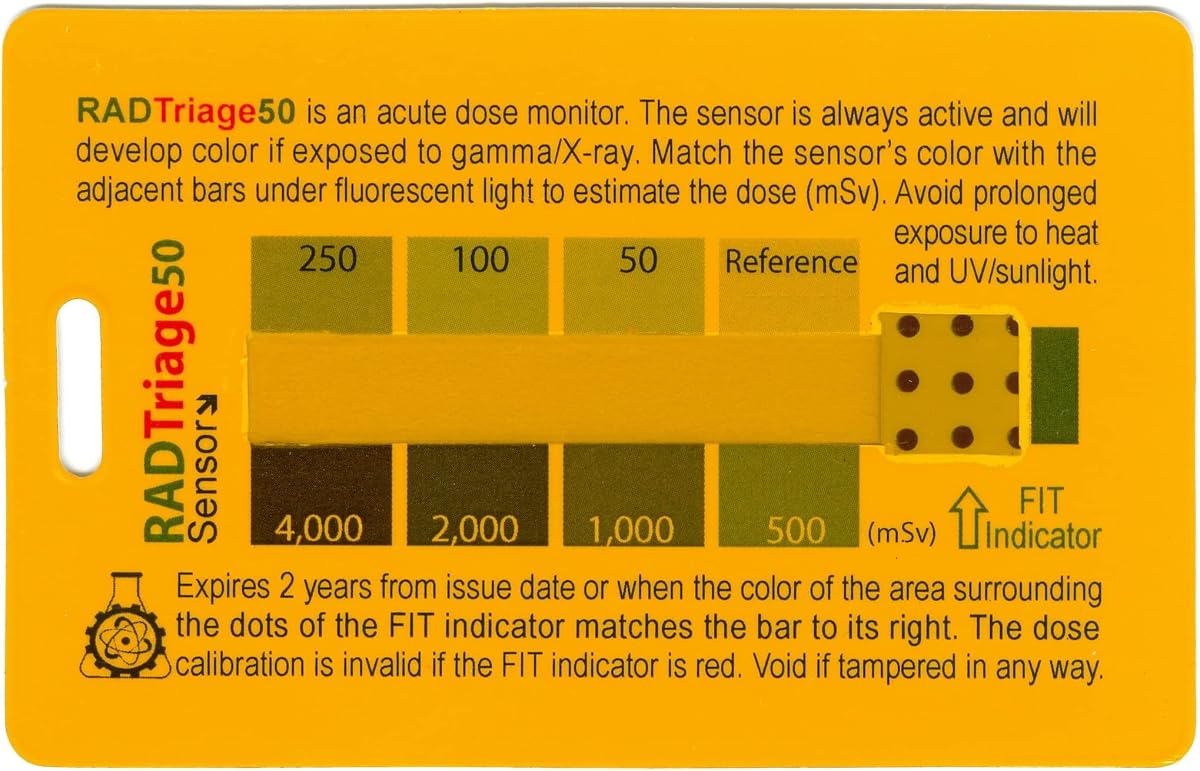
Rad Triage 50
4.4Editor score
Wallet or pocket sized
No batteries required
Military-grade tested
This comprehensive guide compares the top ten dosimeter models available in the market, evaluating their accuracy, features, and usability to help you choose
Finding a reliable dosimeter is essential for anyone concerned about radiation exposure in their environment. Whether you work in healthcare, industry, or simply want peace of mind at home, having a precise device to measure ionizing radiation is crucial for safety.
We have carefully evaluated ten leading dosimeter models based on their detection capabilities, user interface, battery life, and overall value. Each product was analyzed for its ability to detect beta, gamma, and X-ray radiation accurately while providing clear, real-time data to the user.
Each selection in this guide highlights specific strengths and ideal use cases to help you make an informed decision. Please note that product availability and pricing may change frequently, so always check the latest details before making your purchase.
4.4Editor score

4.6Editor score

4.6Editor score
The following table provides a side-by-side comparison of all ten dosimeter models reviewed in this guide, allowing you to quickly assess their key specifications and features to determine which one best fits your requirements.


The GQ GMC-800 stands out as the top choice for anyone seeking a reliable and feature-rich dosimeter. With a rating of 4.6 stars, it offers exceptional accuracy and a large color LCD display that makes reading data effortless even in bright sunlight.
We may earn a commission when you buy through this link, at no additional cost to you.
This device excels in its multifunctional capabilities, providing real-time flux measurement, dosimeter functions, and radiation monitoring over time. It detects Beta, Gamma, and X-ray radiation with precision, ensuring you have comprehensive coverage for various ionizing threats.
While it comes at a higher price point, the investment is justified by the robust features and durability. The ability to set custom alarm thresholds and store data for up to ten years ensures you can track long-term exposure trends effectively.
Ideal for professionals, hobbyists, and safety-conscious individuals, the GMC-800 delivers peace of mind with its comprehensive protection features. Its user-friendly interface and extensive data storage make it a standout tool for serious radiation monitoring.
Detects Beta, Gamma, and X-ray radiation with high precision to ensure complete safety coverage in diverse environments.
Stores up to ten years of data and allows easy transfer to computers for detailed analysis and record-keeping.
We may earn a commission when you buy through this link, at no additional cost to you.
The GQ GMC-300S offers a reliable entry point into radiation monitoring with its solid 4.6-star rating. It provides real-time data logging and downloadable history, making it easy to track radiation levels over time without needing expensive software.
We may earn a commission when you buy through this link, at no additional cost to you.
Its rechargeable battery ensures you can use it for extended periods without worrying about power interruptions. The included free data viewer PC software allows you to analyze recorded data conveniently on your computer.
While it lacks some of the advanced features of higher-end models, its simplicity is a strength. The straightforward interface makes it accessible for beginners who need basic but accurate radiation monitoring capabilities.
This model is perfect for casual users or those monitoring specific areas like basements or workplaces. It balances functionality and cost effectively, providing essential features for safety monitoring.
Logs real-time data every second and allows download to computer for detailed analysis of radiation trends over time.
Features a rechargeable battery that lasts longer than standard models, reducing the need for frequent replacements.
We may earn a commission when you buy through this link, at no additional cost to you.
This upgraded version of the GMC-800 builds on the original's success with enhanced durability and compliance features. It maintains a high rating of 4.6 stars and offers improved functionality for professional and serious users alike.
We may earn a commission when you buy through this link, at no additional cost to you.
The device is designed to meet US national standards, ensuring reliability in critical situations. Its anti-drop design protects it from accidental damage, making it suitable for rugged environments where standard electronics might fail.
Voice alarms and extensive data sharing capabilities add significant value for team safety operations. While the menu system may seem complex at first, the depth of features it offers makes it a powerful tool for comprehensive monitoring.
Ideal for construction sites, laboratories, or emergency response teams, this model ensures accurate readings even in tough conditions. Its robust design and compliance with strict standards make it a trustworthy choice.
Meets US national standards for accuracy and reliability, providing verified protection in critical safety applications.
Includes voice alarms alongside visual and audio alerts to ensure warnings are noticed even in noisy environments.
We may earn a commission when you buy through this link, at no additional cost to you.
The Rad Triage 50 is unique because it requires no batteries and fits easily in a wallet or pocket. With a 4.4-star rating, it provides essential radiation detection for emergency preparedness without the need for power sources.
We may earn a commission when you buy through this link, at no additional cost to you.
Its compact design ensures you always have a radiation detector on hand without the bulk of electronic devices. The shelf life can be extended up to ten years if stored correctly, making it ideal for emergency kits.
While it lacks a digital display and advanced features, it provides instant detection of dangerous radiation sources. This simplicity ensures reliability when electronic devices might fail due to EMP or other disruptions.
This model is perfect for emergency kits and individual safety plans. Its affordability and portability make it a necessary addition for anyone concerned about sudden radiation exposure risks.
Requires no batteries or calibration, ensuring immediate use when emergency situations arise without setup delays.
Can be stored for years with proper conditions, ensuring you have a reliable detector whenever you need it.
We may earn a commission when you buy through this link, at no additional cost to you.
The APOWER RD-3 is a solid all-rounder that balances performance and price effectively. With a 4.4-star rating, it features a precision sensor capable of detecting various radiation types with accurate real-time readings.
We may earn a commission when you buy through this link, at no additional cost to you.
Its triple alarm system ensures you are notified immediately when radiation levels exceed safe thresholds. The color display and easy-to-read interface make it simple to monitor data without confusion.
Battery life is impressive at up to eight days on a single charge, reducing the hassle of frequent recharging. The compact design allows you to carry it easily in a shirt pocket or bag for continuous monitoring.
This device is suitable for home improvement projects, geological surveys, or industrial inspections. Its customizable settings and reliable alarms make it a practical choice for various safety needs.
Triple alarm system ensures immediate awareness when radiation levels are unsafe, protecting users from exposure.
Provides up to eight days of operation on a single charge, making it reliable for extended fieldwork.
We may earn a commission when you buy through this link, at no additional cost to you.
The AEGTEST Radar-5633 offers a comprehensive screen that displays multiple radiation metrics simultaneously. While it has a slightly lower rating of 3.9 stars, it provides excellent visibility for real-time dose rate and cumulative dose monitoring.
We may earn a commission when you buy through this link, at no additional cost to you.
Its battery life is exceptional, lasting up to eighteen days on a single charge. This ensures you can use the device for long periods without interruption, ideal for continuous environmental monitoring.
Custom alarm thresholds allow you to tailor the device to your specific safety requirements. The bright TFT screen is readable in various environments, from dark rooms to outdoor sunlight.
Best suited for users who want detailed metrics without switching screens. Its long battery life and customizable features make it a strong contender for detailed radiation analysis tasks.
Shows multiple radiation metrics on one screen for quick and efficient monitoring without switching modes.
Provides up to eighteen days of battery life, reducing downtime during long-term monitoring projects.
We may earn a commission when you buy through this link, at no additional cost to you.
The HFS-50-CsI is the premium choice for those requiring professional-grade accuracy and features. With a 4.6-star rating and a CsI scintillator sensor, it offers superior interference resistance and stable measurements compared to standard Geiger tubes.
We may earn a commission when you buy through this link, at no additional cost to you.
Its battery life is exceptional at up to 1700 hours in sleep mode, ensuring it is ready when needed without frequent charging. The included telescopic rod helps maintain a safe distance from radiation sources during inspection.
The device stores up to 100 records and offers a 200-second dynamic waveform curve display. This visual data helps users understand radiation trends and fluctuations more intuitively than simple numerical readings.
Best for laboratories, hospitals, or industrial settings where precise measurements are critical. Its robust features and long battery life justify the higher cost for serious professionals.
CsI scintillator sensor provides more stable and accurate measurements compared to traditional Geiger tubes.
Dynamic waveform curve display helps track radiation trends visually for better understanding of exposure data.
We may earn a commission when you buy through this link, at no additional cost to you.
The GQ GMC-500Plus is an enhanced model featuring dual Geiger tubes for improved detection range. It boasts a high rating of 4.6 stars and allows unlimited server logging for comprehensive data tracking.
We may earn a commission when you buy through this link, at no additional cost to you.
Its auto horizontal and vertical large font display makes readings easy to see in any orientation. The onboard speaker and audio output provide immediate auditory feedback when radiation levels change.
While it is an older model, its dual tube design pushes detection limits higher than many single-tube counterparts. This makes it particularly useful for environments with varying radiation intensities.
Ideal for enthusiasts and professionals who value raw detection capability. Its unlimited logging feature ensures you never lose critical data, making it a reliable choice for long-term projects.
Dual Geiger tubes increase detection range and provide more robust monitoring in diverse radiation environments.
Uploads data to any server automatically ensuring no limit on how much information you can store and analyze.
We may earn a commission when you buy through this link, at no additional cost to you.
The MOESAPU FS5000 features a sensitive J321 sensor that makes invisible radiation audible through distinctive click sounds. It offers comprehensive dose tracking and a large 2.4-inch TFT display for clear data visualization.
We may earn a commission when you buy through this link, at no additional cost to you.
Battery life is impressive at up to thirty days on a full charge, supported by low-battery alerts to prevent unexpected shutdowns. The clip design makes it easy to carry on your belt or pocket during daily activities.
Audio haptic alerts ensure you are notified of high radiation levels regardless of your environment. Customizable thresholds allow you to set the device to your specific safety requirements.
Best for users needing a balance of precision and portability. Its long battery life and detailed tracking features make it ideal for monitoring antique collections or renovation projects.
Distinctive click sounds allow you to hear radiation detection instantly providing an intuitive experience.
Provides up to thirty days of battery life ensuring continuous monitoring without frequent interruptions.
We may earn a commission when you buy through this link, at no additional cost to you.
The Soogua Geiger Counter is a practical monitor designed for diverse environments ranging from home improvements to industrial inspections. With a 4.2-star rating, it offers fast response times and clear readings on its LCD display.
We may earn a commission when you buy through this link, at no additional cost to you.
Its alarm modes include sound, vibration, and visual alerts to ensure you are notified regardless of where you are. The device is built to handle various detection scenarios including imported food and seafood checks.
While it lacks detailed historical tracking, its simplicity makes it easy to use for spot checks. The rechargeable battery ensures you can rely on it without frequent replacement costs.
This model is best for casual users or those needing a reliable tool for quick checks. Its versatile application areas make it a useful addition for general safety monitoring needs.
Designed for wide applications from food safety to environmental monitoring providing broad utility for users.
Multi-mode alarm system ensures warnings are seen or felt even in noisy or visually busy environments.
We may earn a commission when you buy through this link, at no additional cost to you.
Selecting the right dosimeter requires careful consideration of several factors including detection accuracy, display quality, and battery life. Understanding these elements will help you find a device that meets your specific safety needs and budget constraints.
The primary function of a dosimeter is to measure radiation levels accurately. Look for devices that specify their energy response range and cumulative dose limits to ensure they cover the types of radiation you expect to encounter. Professional models often include calibration certificates to guarantee precision.
Verify that the device measures the specific types of radiation relevant to your needs such as Beta Gamma and X-ray. Higher accuracy is critical if you are monitoring in industrial or medical environments where safety thresholds are strict.
A clear and readable display is essential for quickly interpreting radiation data. Color LCD screens are generally easier to read in bright sunlight compared to monochrome displays. Look for models that allow you to adjust brightness or change color schemes for comfort.
The user interface should be intuitive to navigate. Menus that are too complex can slow down critical decision-making in emergency situations. Prefer devices with shortcut keys or simplified modes for quick access to key readings.
Effective alarm systems are vital for immediate safety alerts. Many modern dosimeters offer multiple alert types including sound vibration and visual indicators. This ensures you are notified even if one sense is compromised by environmental noise or lighting conditions.
Look for customizable alarm thresholds so you can set the device to alert you only when radiation levels exceed your safety limits. Adjustable alarm sensitivity helps reduce false positives while maintaining high alert reliability.
Battery life determines how long you can use the device continuously. Models with rechargeable lithium batteries are preferable to those requiring disposable cells. Look for devices that offer at least several days of operation on a single charge.
Type-C charging is a modern standard that ensures you can charge the device quickly and with common cables. Some models also offer low-power modes that extend runtime significantly for long-term monitoring projects.
Data storage capabilities are important for tracking exposure trends over time. Devices that store historical data allow you to review past radiation levels and identify patterns. Look for models that retain data even when powered off.
The ability to transfer data to a computer enhances analysis capabilities. Free software or open protocols allow you to generate reports and share data with safety professionals or regulatory bodies easily.
Durability is key for devices used in industrial or outdoor settings. Look for models with anti-drop designs or protective cases to withstand accidental bumps or falls. Water resistance is also a useful feature for environmental monitoring.
The form factor should suit your intended use. Compact handheld devices are ideal for personal monitoring while those with telescopic rods or stand mounts are better for fixed location checks.
The sensor type dictates the device sensitivity and accuracy. Geiger-Muller tubes are common and cost-effective but can be susceptible to interference. Scintillator sensors offer higher precision and stability especially in professional settings.
Consider the energy response range of the sensor. Devices that cover a wide energy range from low to high keV ensure you detect all potential radiation sources accurately.
A solid warranty provides peace of mind and protects your investment. Look for manufacturers offering at least one year of coverage on defects or malfunctions. Support availability for firmware updates and technical queries is also important.
Ensure the device comes with clear manuals and accessible customer support channels. Good support helps you troubleshoot issues quickly and ensures continuous operation during critical periods.
To begin using your dosimeter turn it on and allow it to initialize. Most modern devices will show a quick self-test and then display a baseline reading. Ensure the sensor area is clean and unobstructed to guarantee accurate measurements.
Calibrate the device according to the manufacturer instructions periodically. This ensures accuracy remains reliable over time. If you detect a new environment or if the device is dropped check for any anomalies in the readings.
After use store the dosimeter in a dry cool place away from direct sunlight. Regularly check the battery level and charge it as needed. Clean the exterior with a soft cloth to remove dust or debris that might affect performance.
To verify accuracy check if the device comes with a calibration certificate. You can also test it against a known source or a trusted reference device if available. Regular calibration is recommended to maintain precision over time.
Most modern dosimeters detect Beta Gamma and X-ray radiation. Some models may also detect neutron radiation but this is less common in consumer devices. Check the specifications to confirm which types are covered.
Calibration should be done annually or according to the manufacturer guidelines. If the device is used in harsh environments or shows inconsistent readings it may need more frequent calibration to ensure reliable results.
Most consumer dosimeters are not waterproof. If you need to monitor in wet conditions look for a model specifically rated for water resistance. Keep the device dry to prevent damage to internal components.
Basic dosimeters do not require internet connectivity to function. However some advanced models offer data logging and sharing features that may benefit from a connection for remote monitoring or backup.
Battery life varies by model ranging from a few days to several weeks depending on usage. Most modern devices offer rechargeable batteries that last several days on a single charge with normal operation.
Legal requirements depend on your location and industry. In professional settings you may need certified devices for compliance with safety regulations. Personal use generally does not require certification but accuracy is still important.
If the alarm triggers move away from the source immediately. Check the reading to assess the level and evacuate if necessary. Do not ignore the alarm as it indicates potentially dangerous radiation levels.
Choosing the best dosimeter depends on your specific needs whether for professional use or personal safety. The GQ GMC-800 stands out as the top pick for its comprehensive features while the Rad Triage 50 offers an affordable option for emergency kits.
Prioritize features like accurate detection ranges clear displays and reliable battery life when making your decision. Ensure the device you choose covers the types of radiation relevant to your environment and offers sufficient alarm options.
Always check the latest prices and availability before purchasing as these factors can change frequently. Investing in a quality dosimeter provides peace of mind and ensures you are prepared for any radiation safety challenges.