
1/2'' Flow Hall Sensor
4.7Editor score
Affordable price
Standard NPT thread
Lightweight design
Finding the right flow meter for your Arduino projects can be challenging with so many sensors on the market. You need accuracy, durability, and compatibility to ensure your system tracks water usage effectively.
We analyzed ten popular models based on their flow range, build quality, and ease of integration with microcontrollers. Each option offers unique benefits for different applications like brewing, irrigation, or monitoring.
Every pick below highlights key specs, pros, and cons to help you choose confidently. Remember that availability and pricing may change over time, so verify details before making your final purchase decision.
4.7Editor score

5.0Editor score
3.2Editor score
As an Amazon Associate we earn from qualifying purchases.
This side-by-side comparison covers all ten models to help you see the differences at a glance. Review the key specifications and features to determine which sensor fits your specific requirements best.


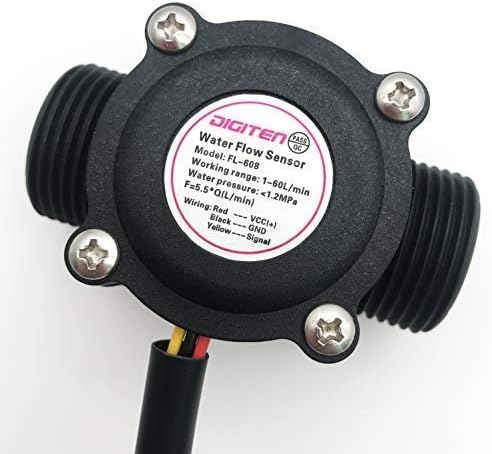
This DIGITEN model stands out as the top choice for users needing a wide flow range and reliable performance. It achieves a perfect rating due to its robust construction and compatibility with popular microcontrollers like Arduino and Raspberry Pi.
We may earn a commission when you buy through this link, at no additional cost to you.
The sensor uses a hall effect mechanism to output square wave pulses, ensuring accurate measurements between five and one hundred fifty liters per minute. Its materials meet ROHS standards, making it safe for potable water applications like reverse osmosis filters.
While it costs more than smaller units, the durability and performance justify the investment for serious projects. Note that if you are connecting to an NPT pipe, you will need to apply thread seal tape to ensure a leak-free fit.
Anyone building a complex water monitoring system should consider this sensor first. It balances high flow capacity with ease of use, making it an ideal pick for both hobbyists and professionals.
Handles large volumes efficiently for industrial or heavy-duty residential applications.
ROHS compliant materials ensure safety when measuring drinking water or beverages.
We may earn a commission when you buy through this link, at no additional cost to you.
This sensor offers an excellent entry point for beginners looking to measure water flow without breaking the bank. It features a standard NPT thread and works seamlessly with common microcontrollers for various monitoring tasks.
We may earn a commission when you buy through this link, at no additional cost to you.
The hall effect sensor inside outputs an electrical pulse with every revolution of the internal rotor. This design keeps the electronics sealed and dry, protecting them from water damage while providing consistent data for your code.
It is important to install it in the correct direction as indicated on the product, or it will not output signals. While the flow range is limited to thirty liters per minute, it suits most home applications well.
Choose this if you need a simple, cost-effective solution for basic water tracking. Its lightweight build and standard connection make it highly versatile for small scale projects.
Great for prototyping or adding flow tracking to multiple projects on a budget.
Internal sensors are isolated from water to prevent shorts and extend lifespan.
We may earn a commission when you buy through this link, at no additional cost to you.
This unit provides a larger diameter option for users working with bigger pipes or higher flow requirements. The included cable extends reach significantly, allowing for flexible installation in tight spaces or distant setups.
We may earn a commission when you buy through this link, at no additional cost to you.
Its hall effect sensor ensures reliable pulse output within a range of one to sixty liters per minute. Like other premium models, it meets ROHS standards, making it safe for use with drinking water systems.
Despite its features, it has a lower user rating which may reflect installation complexity or specific usage conditions. Buyers should weigh the need for a larger pipe against potential setup challenges.
It is best suited for installations where standard sizes are insufficient and cable length matters. Verify thread requirements carefully before purchasing to avoid needing extra adapters.
Long cable allows sensor placement away from the main controller unit.
Accommodates larger water lines typical in industrial or heavy residential use.
We may earn a commission when you buy through this link, at no additional cost to you.
This DEVMO sensor is particularly well suited for applications involving water cooling systems or specific industrial devices. It boasts a very high rating from users who appreciate its stability and strong electrical output characteristics.
We may earn a commission when you buy through this link, at no additional cost to you.
The product features a high amplitude output signal that ensures clear pulse detection by your microcontroller. It handles a standard flow range of up to thirty liters per minute with reliable performance under typical pressure conditions.
Its electrical strength rating indicates it can withstand specific voltage conditions during operation, adding to its reliability in demanding environments. However, users should ensure their power supply matches the required voltage levels.
Consider this option if your project involves cooling loops or needs a robust signal for reliable counting. It balances performance and cost effectively for specialized applications.
High amplitude ensures the Arduino can easily read pulse signals.
Designed to function well within water cooling loops for computers or motors.
We may earn a commission when you buy through this link, at no additional cost to you.
This sensor is designed with safety in mind, using food grade plastic that meets ROHS testing standards. It is an excellent choice for projects involving beverages, coffee machines, or water purifiers where contact with consumables is required.
We may earn a commission when you buy through this link, at no additional cost to you.
The hall effect mechanism ensures accurate pulse output for flow rates up to thirty liters per minute. It operates within a wide voltage range, allowing flexibility in power supply options for your project.
Users should note that the pressure limit is capped at a specific level, which might not suit high pressure mains. For typical household appliance use, this limit is generally sufficient and safe.
Choose this model when health and safety are primary concerns in your setup. Its food safe materials make it suitable for any application involving drinking water or food processing.
Food grade plastic ensures no harmful contaminants enter your water supply.
Perfect for coffee makers, purifiers, and small beverage machines.
We may earn a commission when you buy through this link, at no additional cost to you.
This unique sensor features a transparent body that allows you to visually inspect the water flow and rotor condition directly. It comes in a pack of two, offering excellent value if you need multiple sensors for different projects.
We may earn a commission when you buy through this link, at no additional cost to you.
The impeller is internally inlaid with stainless steel beads which improve wear resistance over time. This design ensures the rotor rotates smoothly and consistently even after extended use in varying flow conditions.
While the transparent material facilitates observation, it may be slightly less durable than opaque plastic under high stress. Users should handle the casing with care during installation to avoid cracking the clear body.
It is ideal for educational projects or setups where visual flow confirmation is helpful. The dual pack allows you to compare setups or backup your system without additional purchases.
Transparent body allows you to see water flow and rotor position instantly.
Includes two sensors which is great for building multiple test rigs.
We may earn a commission when you buy through this link, at no additional cost to you.
This smaller sensor is specifically designed for low flow applications such as aquariums, small pumps, or misting systems. It connects directly to a standard hosepipe, making it simple to integrate into existing tubing setups.
We may earn a commission when you buy through this link, at no additional cost to you.
The food grade plastic ensures safety for water that might contact consumables. Its flow range is optimized for precision at low volumes, detecting flow rates starting from point three liters per minute accurately.
The compact size means it takes up very little space in your build, which is crucial for tight enclosures. Ensure your hose inner diameter matches the connector requirements to prevent leaks.
Select this model if your project involves slow water movement and limited space. Its focus on low flow precision makes it a specialized tool for specific niche applications.
Captures small volume changes that larger sensors might miss.
Directly connects to common garden hoses for quick setup.
We may earn a commission when you buy through this link, at no additional cost to you.
This Taidacent sensor is recognized for its simplicity and reliability in detecting water flow rates accurately. It uses a magnetic rotor assembly that spins with the flow, driving the hall sensor to produce clear pulses for your controller.
We may earn a commission when you buy through this link, at no additional cost to you.
Its perfect user rating suggests high satisfaction with its build quality and performance in typical home water systems. It is often used in water heaters to detect incoming flow rates for regulation purposes.
The unit features a standard G1/2 interface which fits many common plumbing components. While the design is straightforward, it delivers consistent results over time without complex calibration needs.
This is a solid choice for standard water heating or dispensing tasks where reliability is paramount. Its reputation for consistent performance makes it a dependable component for your builds.
Magnetic rotor ensures consistent pulse generation under varying flow.
G1/2 thread connects easily to standard pipes and adapters.
We may earn a commission when you buy through this link, at no additional cost to you.
This model from DIGITEN adds convenience by including a one meter cable directly attached to the unit. This extension allows you to place the sensor in tight spots while connecting your controller from a safer distance.
We may earn a commission when you buy through this link, at no additional cost to you.
With a high user rating, it has proven reliable in various applications including reverse osmosis filters and water heaters. The materials comply with ROHS standards, ensuring safety for drinking water environments.
The connector type is SM2.54, which might require checking your existing wiring setup. If you are using NPT pipes, remember to use thread seal tape to prevent any potential leaks during operation.
Choose this for projects where distance or flexibility is a priority. It combines standard performance with added convenience for easier physical installation and wiring.
Saves you from needing extra wires or adapters for long runs.
Strong user feedback confirms durability and accurate measurement.
We may earn a commission when you buy through this link, at no additional cost to you.
This unit is one of the smallest options available, featuring a G3/8 thread that fits into compact systems easily. It detects very low flow rates starting from zero point three liters per minute with good accuracy.
We may earn a commission when you buy through this link, at no additional cost to you.
Like other DIGITEN models, it is built with durable materials that resist heat and cold effectively. The square wave output ensures that your microcontroller can count pulses consistently for total flow calculations.
It is ideal for small scale water dispensers or drip irrigation systems where space is tight. Ensure your pipe thread matches the sensor to avoid needing additional converters or adapters.
Pick this if you have a specific constraint requiring a small diameter connection. It balances cost and function well for light duty measurement tasks.
Fits easily in crowded plumbing setups where space is limited.
Sensitive enough to track slow drips or small volume flows.
We may earn a commission when you buy through this link, at no additional cost to you.
Selecting the right flow meter involves evaluating several technical factors to match your specific project needs.
The most critical specification is the flow rate range the sensor can accurately measure. Most Arduino compatible sensors work between one and thirty liters per minute, but larger models support higher volumes. Always check the minimum and maximum limits to ensure they cover your expected usage.
Choose a sensor whose range fully covers your operational requirements without being too large for small flows.
Thread compatibility is essential for connecting the sensor to your water lines. Common sizes include G1/2, G3/8, and G1.5 inches depending on the application. Make sure you match this to your existing pipes or have the right adapters ready.
Always verify the thread type and size before purchasing to prevent installation issues later.
Different sensors operate at different voltage levels which must match your microcontroller's logic levels. Most models work with 5V DC, but some support a wider range up to 24V. Ensure your power supply is stable to avoid signal noise.
Check the voltage range in the specifications to ensure it aligns with your Arduino or Raspberry Pi setup.
The output signal type dictates how you read data from the sensor. Most use a hall effect pulse that sends a square wave signal to a digital pin. This makes programming simple using interrupt functions on your board.
Ensure the output signal is compatible with your microcontroller's interrupt pins for reliable counting.
If you plan to measure potable water, check that the materials meet food grade standards. Many models use ROHS compliant plastics that are safe for drinking water. This prevents chemicals from leaching into your water supply.
Prioritize food safe materials if the sensor will contact water intended for human consumption.
Some models come with pre-attached cables while others have wires that you may need to extend. Longer cables offer more flexibility in mounting the sensor away from the controller. Consider where you will place the device before buying.
Select a model with sufficient cable length to avoid adding extra wires that could weaken the connection.
Every sensor has a maximum pressure rating it can handle without leaking or breaking. Most standard models handle up to 1.75MPa. Exceeding this limit can cause permanent damage to the internal components.
Always verify that your system pressure stays below the sensor's rated maximum.
Ease of installation depends on the physical design and thread type. Smaller units are lighter and easier to handle but might require more precise alignment. Look for compact models that allow simple tightening by hand.
Opt for a model with clear flow direction markings to simplify the installation process.
Install the sensor by screwing it into the pipe in the direction of flow indicated by the arrow on the body. Use thread seal tape on metal threads to prevent leaks and ensure a tight seal.
Connect the three wires to your microcontroller ensuring power, ground, and signal lines are correctly matched. Write code using interrupts to count the pulses and calculate the flow rate based on the sensor constant.
Periodically inspect the sensor for debris that might obstruct the rotor. If flow drops unexpectedly, clean the intake area and check for any blockages in your plumbing system.
An Arduino flow meter typically uses a small internal turbine that rotates as water passes through. A magnetic hall effect sensor detects each rotation and sends an electrical pulse to the Arduino. By counting these pulses over time, the microcontroller calculates the flow rate.
Most hall effect flow sensors are designed for cold to moderate temperatures. Prolonged exposure to very hot water may damage the internal seals or plastic parts. Check the specific product ratings for temperature tolerance before using with hot water.
Yes, using a library simplifies the process by handling pulse counting automatically. Libraries like PulseIn or dedicated Flow Sensor libraries help you calculate liters per minute accurately. They reduce the complexity of writing raw interrupt code.
The difference lies in the pipe diameter the sensor connects to. G1/2 fits larger pipes typical of main lines while G3/8 suits smaller plumbing runs. Ensure you match the thread size to your existing pipe to avoid leaks.
Use thread seal tape on all metal threads before screwing the sensor into the pipe. Tighten the connection firmly but avoid overtightening which could crack the housing. Check all connections for moisture before full operation.
Yes, these sensors output digital pulse signals compatible with Raspberry Pi GPIO pins. You may need a pull up resistor or logic level shifter depending on the voltage. Libraries exist to help you read the flow data easily.
We reviewed ten top flow sensors ranging from budget friendly units to large capacity industrial models. Each offers unique benefits depending on your required flow rate and pipe size.
Prioritize flow range and thread compatibility when deciding. A sensor must handle your system pressure and fit your plumbing to work reliably over time.
Prices and availability change frequently so always check the current details before buying. Pick the model that fits your project scale best.