
RIGOL DHO924S
4.5Editor score
Built-in signal generator
250MHz bandwidth
Advanced Bode plot
Digital oscilloscopes are essential tools for engineers and hobbyists needing to visualize electrical signals. They convert voltage changes into graphs allowing detailed analysis of waveforms noise and timing in modern electronic circuits and systems.
We evaluated ten leading models based on bandwidth sampling rate resolution and user interface. Each product was reviewed for its ability to capture glitches decode serial protocols and offer portability for field work or lab bench testing.
Each pick highlights specific strengths like affordability premium features or specialized functions. Prices and availability change frequently so always check current listings before purchasing. Our guide ensures you find the best scope for your specific debugging needs.
4.5Editor score
4.3Editor score

4.4Editor score
As an Amazon Associate we earn from qualifying purchases.
This comparison table lists all ten products side by side. It highlights key specifications such as channel count bandwidth and unique features like spectrum analysis or built-in multimeters to help you decide quickly.


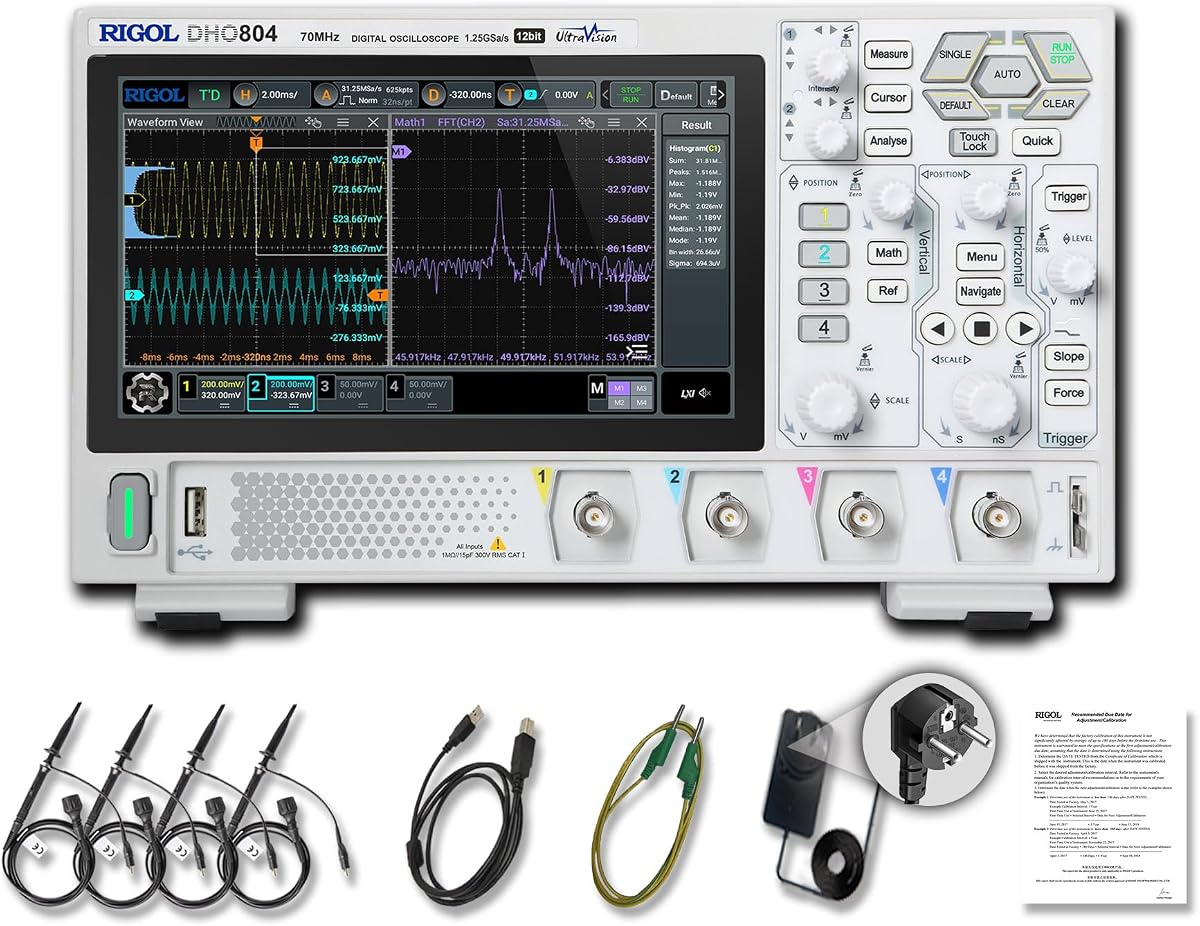
The RIGOL DHO804 stands out as a premium portable oscilloscope with exceptional clarity. Its 12-bit resolution reveals details that typical 8-bit scopes miss. It is perfect for engineers needing accurate power analysis.
We may earn a commission when you buy through this link, at no additional cost to you.
This model features UltraAcquire technology which captures millions of waveforms per second. This helps in finding rare glitches easily. The 7-inch touchscreen and Flex Knob make navigation intuitive for daily tasks.
While the bandwidth is limited to 70MHz it excels in precision. It is not ideal for very high-speed digital signals. However for power supply testing it offers superior vertical detail.
Buy this if you need portability and accuracy on a budget. It balances features well. The connectivity options like LAN and HDMI support remote workflows effectively.
The 12-bit ADC allows measuring ripple noise with high vertical resolution. This is vital for modern switching power supply validation.
The touch screen and web control enable quick setup and documentation. It speeds up lab workflows significantly.
We may earn a commission when you buy through this link, at no additional cost to you.
The DHO924S is a high-end unit combining oscilloscope and signal generator. It offers 250MHz bandwidth with 12-bit resolution. This makes it a complete lab station for advanced debugging.
We may earn a commission when you buy through this link, at no additional cost to you.
Key features include Bode plot analysis and loop response testing. These tools help in designing stable power systems. The integrated AFG removes the need for extra equipment on your bench.
Its advanced capabilities come at a higher cost. It might be overkill for simple hobby tasks. But for professionals it provides unmatched convenience and analysis power.
Choose this for complex embedded system validation. It simplifies testing workflows significantly. The remote access features are excellent for documentation and sharing.
Built-in AFG and Bode plots allow complete system characterization. This reduces hardware clutter and setup time.
Web control and LAN support enable easy integration into automated test systems. It is great for remote labs.
We may earn a commission when you buy through this link, at no additional cost to you.
The DPOS350P offers a unique combination of tools including a spectrum analyzer. With 350MHz bandwidth it handles fast signals well. It is a strong contender for general electronics testing.
We may earn a commission when you buy through this link, at no additional cost to you.
Its spectrum analyzer and frequency response tools are rare at this price. This helps in EMI checks and audio frequency analysis. The 7-inch touchscreen makes viewing data easy.
However the sampling rate is lower than high-end models. It may miss some very fast edge details. But for most applications it provides good value.
Buy this for EMI and frequency analysis. It replaces multiple devices. The battery life supports field work effectively.
FFT capability helps detect interference frequencies quickly. Useful for audio and RF troubleshooting.
Built-in frequency response allows Bode plots without extra tools. Great for filter tuning.
We may earn a commission when you buy through this link, at no additional cost to you.
The DS1102Z-E is a proven model with high user ratings. It offers deep memory for long captures. This makes it a reliable choice for education and repair work.
We may earn a commission when you buy through this link, at no additional cost to you.
Its high waveform capture rate helps find intermittent glitches. Serial protocol decoding is built-in for microcontrollers. The digital phosphor display shows signal history clearly.
While it has only two channels it is stable. It lacks some modern touchscreen features. But it performs consistent tasks well.
Ideal for students and repair technicians. It is affordable and durable. The memory depth allows detailed event analysis.
Up to 24 Mpts memory captures long events at full speed. Essential for debugging rare issues.
Built-in UART I2C and SPI decoding speeds up embedded debugging. Saves time on analysis.
We may earn a commission when you buy through this link, at no additional cost to you.
The 2C53T combines scope multimeter and generator. It fits in a backpack easily. The built-in multimeter makes it a complete field tool.
We may earn a commission when you buy through this link, at no additional cost to you.
With 50MHz bandwidth it handles audio and power signals. The signal generator allows injecting test signals. The FPGA architecture ensures stable performance.
The screen is small at 2.8 inches. It is not great for detailed waveform inspection. But for quick checks it is efficient.
Buy this for field maintenance. The combo reduces tool load. It is perfect for basic repair tasks.
Combines three tools in one case. Saves space in field kits.
Measures voltage current and resistance instantly. Great for quick checks.
We may earn a commission when you buy through this link, at no additional cost to you.
The DSO152 is the most affordable option. It fits in a pocket. Great for checking simple signals like motors or audio.
We may earn a commission when you buy through this link, at no additional cost to you.
It has auto-setting which makes it beginner friendly. The long battery life supports hours of use. It is a solid first scope.
Bandwidth is limited to 200kHz. It cannot handle fast digital signals. But for basics it works well.
Best for hobbyists on a budget. It teaches basics without breaking the bank. Keep it as a backup tool.
One-button auto setup simplifies use. No complex menu navigation.
Small size and light weight make it easy to carry. Good for field checks.
We may earn a commission when you buy through this link, at no additional cost to you.
The DSO2D15 offers 150MHz at a low price. It supports 14 trigger modes for stability. It is useful for embedded debugging and learning.
We may earn a commission when you buy through this link, at no additional cost to you.
Serial protocol decodes help analyze data. Arbitrary waveform output adds testing capability. It balances cost and function well.
The interface is basic compared to touch models. It requires manual knob adjustments. But it gets the job done.
Buy this for lab benches with multiple tools. It saves money without sacrificing core features. Reliable for education.
14 trigger modes stabilize complex signals. Essential for noisy environments.
Built-in serial support simplifies debugging. Reduces need for PC software.
We may earn a commission when you buy through this link, at no additional cost to you.
The 1013D Plus brings a touchscreen to the budget range. It has 100MHz bandwidth and 1GB storage. Ideal for visualizing waveforms easily.
We may earn a commission when you buy through this link, at no additional cost to you.
Lissajous graphic display helps compare signals. FFT viewing allows spectral estimation. The 4-hour battery life supports mobile work.
It lacks advanced protocol decoding. It is best for analog signals. But the interface is intuitive.
Choose this for visual debugging. It looks modern and costs less. Good for general purpose use.
Capt capacitive touch speeds up setup. Easier than knob navigation.
Stores 1000 sets for review. Helps track signal changes.
We may earn a commission when you buy through this link, at no additional cost to you.
This product listing is currently unavailable. Please check the Amazon link for updates. It may be replaced by newer models.
We may earn a commission when you buy through this link, at no additional cost to you.
We recommend looking at the other reviewed scopes. They offer similar features. The market changes quickly.
Availability affects purchase decisions. Always verify stock before ordering. Avoid out of stock items.
We update the list regularly. Ensure you pick a available model. The alternatives are strong.
Listing status is unverified. Check seller availability.
The reviewed models above are reliable. Consider them as replacements.
We may earn a commission when you buy through this link, at no additional cost to you.
Choosing the right oscilloscope requires understanding your testing needs and the signals you analyze.
Bandwidth determines the highest frequency the scope can measure accurately. For general electronics 100MHz is often enough but high-speed digital requires 500MHz or more.
Choose bandwidth at least five times your signal frequency.
Sampling rate is how many samples per second the scope takes. Higher rates capture fast edges and glitches accurately. Look for at least 2.5 GSa/s for detailed analysis.
Ensure sampling rate is 2.5 to 5 times bandwidth.
Memory depth allows longer captures at high resolution. It helps in viewing rare events without losing data. Deep memory is key for serial protocol decoding.
Select scopes with at least 1M points per channel.
Resolution defines the vertical detail the scope can resolve. 8-bit is standard but 12-bit provides better ripple and noise analysis. It is crucial for power supply debugging.
Opt for 12-bit resolution for precision work.
Channels allow viewing multiple signals simultaneously. Two channels suffice for basic circuits but four are needed for complex systems. Consider expansion options for flexibility.
Choose 4-channel for advanced debugging.
Connectivity like USB LAN and Wi-Fi enables remote control and data export. This is vital for automated testing and documentation workflows.
Look for LAN and USB support for modern labs.
Field engineers need compact and battery-powered scopes. Handheld units are great but bench models offer better display and performance. Assess where you will use the scope.
Select portable models for field work.
Budget ranges vary from $50 to thousands. Balance features against cost. High-end scopes offer better specs but entry-level options work for beginners.
Pick a model fitting your budget and needs.
Start by grounding the scope and connecting the probes correctly. Auto-set the display to visualize basic signals quickly.
Use trigger controls to stabilize waveforms. Adjust time and voltage divisions to see detail.
Clean the screen with a soft cloth and store the device in a safe place. Regular calibration maintains accuracy.
Digital scopes convert signals into data for storage and analysis. Analog scopes show voltage directly on a CRT. Digital scopes are easier to use and offer better measurement tools.
Only if you analyze multiple signals at once. Two channels are sufficient for most repair and hobby work. Four channels add cost but help with complex debugging.
Arduino signals are slow so 100MHz is more than enough. 50MHz is also acceptable. You need higher bandwidth only for fast digital buses like HDMI.
Higher sampling rates capture more points per cycle. This reduces aliasing and shows accurate shapes. Low sampling rates can distort high-frequency signals.
Handheld scopes are accurate for basic measurements. They lack deep memory and advanced triggers. They are great for field checks but not complex analysis.
High-resolution scopes like 12-bit show small voltage changes. They are essential for power supply ripple and noise. Standard 8-bit scopes might miss these details.
A serial decoder interprets communication protocols like I2C. It translates raw signals into readable data. This saves time when debugging microcontroller communication.
Yes scopes visualize audio waveforms well. They help check distortion and frequency response. A frequency analyzer feature helps further.
The RIGOL DHO804 and DHO924S lead in precision and features. For budget buyers the FNIRSI DSO152 is a great start.
Focus on bandwidth and resolution for your specific signals. Ensure the scope has enough memory for your needs.
Check current prices and availability on Amazon. Our guide updates regularly to reflect new models.