
Nayax VPOS Touch Cashless Payment Reader
4.0Editor score
Customizable Touchscreen Interface
Anti-Vandal Durability Design
Advanced Marketing Tools Suite
Compare the top card readers for vending machines to find secure cashless payment solutions with real-time telemetry and wide connectivity options for modern
Modern vending operations rely heavily on secure cashless payment solutions to maximize revenue and customer satisfaction. Choosing the right card reader ensures seamless transactions and reduces downtime caused by payment failures or connectivity issues.
We evaluated leading models based on payment acceptance, connectivity options, security compliance, and ease of integration. Our analysis covers devices designed specifically for unattended environments, focusing on reliability and real-time management capabilities.
Each pick highlights key features, strengths, and potential trade-offs to help you decide based on your specific machine requirements. Prices and availability fluctuate, so verify current details before purchasing to ensure compatibility with your existing setup.
4.0Editor score
3.8Editor score

3.5Editor score
The following comparison table outlines key specifications for each model to help you quickly identify the most suitable device for your vending infrastructure requirements and budget constraints.


The VPOS Touch stands out as a comprehensive cashless solution designed specifically for unattended retail environments. It accepts a wide range of payment methods including EMV chips and contactless wallets, ensuring customers can pay effortlessly.
We may earn a commission when you buy through this link, at no additional cost to you.
Its integrated 4G LTE antenna eliminates the need for separate Wi-Fi or ethernet setups, making installation straightforward. The accompanying management suite allows operators to monitor sales and inventory remotely, providing real-time alerts for maintenance.
While the device offers robust connectivity, users must complete an activation process before use, which can take up to ten business days. This delay might inconvenience operators needing immediate deployment, though it ensures proper account setup.
Operators seeking a reliable, secure, and easy-to-manage payment system will find this device highly suitable. Its ability to work across various machine types makes it a versatile choice for expanding cashless capabilities.
Supports EMV, NFC, and magnetic stripe payments to accommodate diverse customer preferences.
Enables operators to track sales and inventory levels from anywhere via a secure portal.
We may earn a commission when you buy through this link, at no additional cost to you.
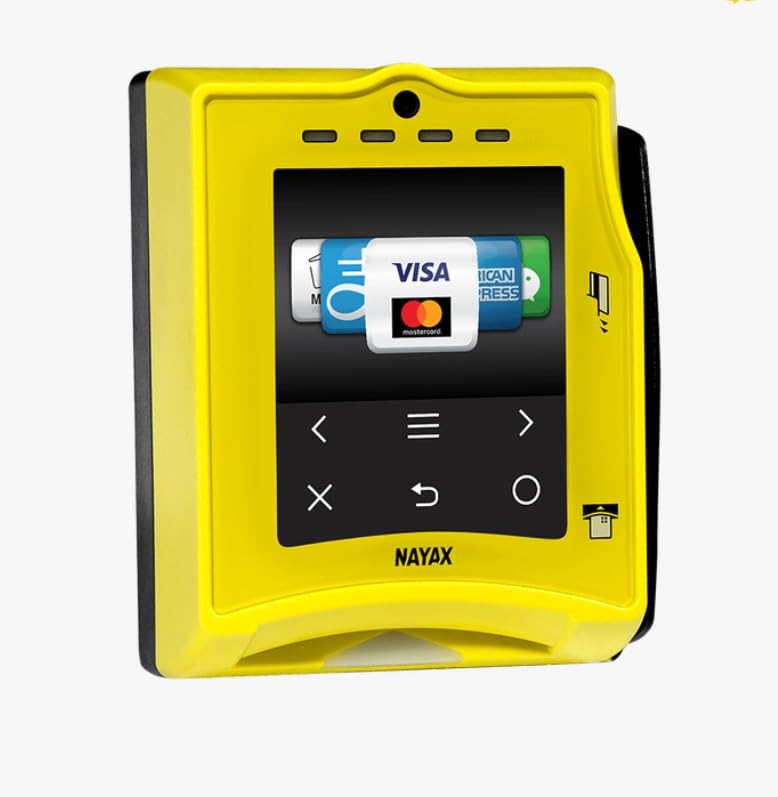
The Nayax VPOS Touch offers a premium experience with its customizable color touchscreen and advanced marketing capabilities. It supports a wide array of payment methods including mobile wallets and QR codes, enhancing user convenience.
We may earn a commission when you buy through this link, at no additional cost to you.
Built to withstand harsh environments, the device features Dragontrail glass and IP55 ratings, ensuring longevity even in high-traffic or outdoor locations. Remote software updates keep the system current without requiring physical access.
However, the device comes at a higher price point compared to standard readers, which may not suit all budgets. Additionally, the setup process involves multiple steps to configure marketing tools and telemetry settings correctly.
Ideal for operators prioritizing customer engagement and durability, this reader provides a robust platform for modernizing unattended machines. Its marketing tools can help drive repeat visits and increase overall transaction value.
Color LCD with voice prompts and multi-language support improves the payment experience.
Shock detection and IP55 rating protect against vandalism and environmental damage.
We may earn a commission when you buy through this link, at no additional cost to you.
The Verifone VX520 provides a solid, budget-friendly option for operators needing basic EMV and NFC capabilities. It is well-established in the payment industry, offering reliability and compliance with current security standards.
We may earn a commission when you buy through this link, at no additional cost to you.
This device supports both dial and ethernet connectivity, giving flexibility depending on available infrastructure. It also handles smart cards and contactless payments, ensuring compatibility with modern banking cards.
While reliable, it lacks the advanced telemetry and touchscreen features found in newer models, which might limit operational insights. The interface is also more traditional, which could feel less intuitive for tech-savvy users.
For operators looking for a straightforward, compliant payment terminal without unnecessary bells and whistles, this model delivers consistent performance. It is particularly useful for upgrading older machines to accept chip cards.
Supports both dial-up and ethernet connections to adapt to various site conditions.
Meets EMV standards to protect transaction data and reduce liability.
We may earn a commission when you buy through this link, at no additional cost to you.
This generic model provides a standard solution for basic card reading needs with a focus on simplicity. It includes a yellow instruction sheet that guides users through the necessary activation steps before use.
We may earn a commission when you buy through this link, at no additional cost to you.
The activation process requires submission and can take up to ten business days to complete, which might delay deployment. However, once activated, it offers standard card reading capabilities suitable for general vending operations.
Limited documentation beyond the instruction sheet may challenge users unfamiliar with payment terminal setups. There is also minimal information available regarding specific compatibility with advanced protocols like MDB or Pulse.
Operators looking for a no-frills device for straightforward transactions may find this acceptable, provided they plan ahead for the activation timeline. It serves as a functional entry point into cashless payments.
Follows a clear set of steps outlined in the included instruction sheet.
Designed for general use without advanced feature requirements.
We may earn a commission when you buy through this link, at no additional cost to you.
The Symcode Multi-Function Reader offers versatility with support for magnetic cards, memory chips, and NFC. It is designed to work with cashier registers and KIOSK machines, making it adaptable for various settings.
We may earn a commission when you buy through this link, at no additional cost to you.
It supports three reading modes including swipe, insert, and contactless, providing flexibility in how cards are processed. The keyboard emulator mode allows for easy integration into systems that rely on input simulation.
However, it is a read-only device, meaning it cannot encode or write data to cards. This limitation restricts its use for applications requiring member card encoding or complex data writing tasks.
For operators needing a flexible USB reader for basic card data capture, this device provides multiple options at a reasonable price. Ensure compatibility with your specific system requirements before purchase.
Offers swipe, insert, and contactless options for different card types.
Works in passive mode via software for custom development needs.
We may earn a commission when you buy through this link, at no additional cost to you.
This device is designed for membership systems and check-in checkout scenarios with support for various chip types including SLE4442 and CPU chips. It includes an SDK and software CD for developers needing custom integration.
We may earn a commission when you buy through this link, at no additional cost to you.
It supports reading all three tracks of magnetic cards and offers compatibility with Mifare RFID and PSAM cards. The user guide on the CD provides additional resources for navigating its features and functions.
However, magnetic card reading is read-only, preventing encoding capabilities for magstripe cards. Deep development requires understanding APDU commands, which might be too complex for casual users.
For technical operators building custom member systems, this reader offers extensive capabilities at a competitive price. Ensure your team has the necessary skills to utilize the SDK effectively.
Handles SLE4442, CPU, Mifare RFID, and PSAM cards for diverse needs.
Includes SDK and manual to facilitate custom application building.
We may earn a commission when you buy through this link, at no additional cost to you.
The E-seek M-260 is specialized for scanning government-issued IDs with magnetic stripes and 2D barcodes in one device. It serves well for POS and law enforcement environments where accurate identity verification is critical.
We may earn a commission when you buy through this link, at no additional cost to you.
Its bottom-mounted interface connector makes it ideal for kiosk applications where space and cable management are concerns. Data transfers via standard USB, ensuring compatibility with most host devices and operating systems.
While excellent for ID verification, this device is not designed for general payment processing like credit cards. It focuses on authentication and access control rather than financial transaction capabilities.
Operators requiring robust ID scanning for membership verification or access control will find this a reliable solution. Its design specifically targets environments where dual technology reading is essential.
Combines magnetic stripe and 2D barcode scanning for thorough verification.
Bottom connector allows for discreet and organized kiosk installations.
We may earn a commission when you buy through this link, at no additional cost to you.
The VP3350 is a compact reader designed for mobile-friendly environments with support for contactless and EMV transactions. It requires a new merchant account with SwyftPAY before shipment, streamlining onboarding for new users.
We may earn a commission when you buy through this link, at no additional cost to you.
It is PCI P2PE compliant, ensuring secure transaction processing, and supports EMV contact and contactless methods. The device is compatible with CardPointe Virtual Terminal and various API options for integration.
The requirement for a specific merchant account may limit flexibility for operators who prefer to maintain existing banking relationships. This setup can be a hurdle for those already using different payment processors.
Ideal for new ventures or mobile operators needing a complete payment solution, this device offers simplicity and security. The included stand enhances usability for counter or handheld use cases.
Meets PCI P2PE standards to protect sensitive customer data during transactions.
Works with CardPointe Gateway API for seamless software connections.
We may earn a commission when you buy through this link, at no additional cost to you.
The MTMS15 offers advanced security through multi-factor authentication using both card and PIN inputs. This open architecture solution allows for flexible integration into complex security or access systems.
We may earn a commission when you buy through this link, at no additional cost to you.
It supports mobile NFC and provides networked real-time data, enabling operators to monitor transactions as they occur. This level of connectivity is beneficial for high-security environments requiring immediate reporting.
However, the added complexity of multi-factor requirements might not suit all vending scenarios, especially those prioritizing speed over security. The specific focus on PIN entry adds steps to the transaction process.
Operators requiring heightened security measures or PIN-based access control will find this model valuable. It balances advanced functionality with practical usability for specialized applications.
Requires both card and PIN for transaction verification to reduce fraud.
Networked capabilities allow instant access to transaction and inventory data.
We may earn a commission when you buy through this link, at no additional cost to you.
The X6BT VIP offers portable card reading and encoding capabilities with Bluetooth connectivity for mobile devices. It supports major operating systems including Windows, MacOS, iOS, and Android, making it highly versatile.
We may earn a commission when you buy through this link, at no additional cost to you.
It reads and writes all three tracks of magnetic cards, adhering to ISO 7811 standards. The included free software facilitates easy setup and usage across different platforms without additional licensing fees.
Because it relies on mobile apps for operation, it may require additional hardware like smartphones or tablets. Battery life and connectivity range are also factors to consider during deployment in remote locations.
Ideal for mobile operators needing flexible card encoding and reading without wired constraints, this device provides strong compatibility. Ensure mobile devices are available to fully utilize its wireless features.
Works with iOS, Android, Windows, and MacOS for broad system support.
Enables writing data to all three tracks for encoding and membership functions.
We may earn a commission when you buy through this link, at no additional cost to you.
Selecting the right card reader involves evaluating several technical and operational factors to ensure compatibility, security, and efficiency for your specific vending environment.
Ensure the reader accepts EMV chip cards, contactless NFC payments like Apple Pay, and traditional magnetic stripes. Modern consumers expect diverse payment options, so broader support typically leads to higher transaction volumes.
Look for devices that explicitly state support for mobile wallets and contactless transactions to stay current with payment trends.
Determine whether your machine requires cellular, Wi-Fi, or ethernet connectivity. Devices with integrated 4G LTE antennas simplify installation by removing the need for external network hardware or separate setup steps.
Choose connectivity that matches your site infrastructure to avoid additional costs for routers or modems.
Verify that the device supports the communication protocol your vending machine uses, such as MDB or Pulse. Mismatched protocols can lead to integration failures or require expensive adapters.
Always check the manufacturer documentation to confirm protocol alignment with your existing machine controller.
Security is paramount when handling financial data. Ensure the reader is PCI DSS compliant and includes encryption features to protect customer information from breaches.
Selecting certified devices reduces liability and builds trust with your customers regarding payment safety.
Advanced readers often come with remote management software that allows you to monitor sales and inventory levels in real time. This feature helps operators anticipate restocking needs and identify payment issues quickly.
Prioritize models with intuitive dashboards and mobile alerts to streamline daily operational tasks.
Unattended machines face physical and environmental stress, so durability is key. Look for models with impact-resistant materials and IP ratings to protect against dust, moisture, and vandalism.
A robust enclosure extends device lifespan and reduces maintenance costs over time.
Consider how much technical expertise is needed to set up and maintain the reader. Some devices offer plug-and-play functionality while others require custom configuration or merchant account setups.
Choose a device that aligns with your team's technical capability to avoid downtime during installation.
Beyond the initial purchase price, factor in ongoing fees such as merchant processing rates, activation fees, or subscription costs for telemetry services. These recurring expenses affect your long-term profitability.
Calculate the total expected cost to ensure the device fits within your operational budget.
Begin by installing the device securely according to manufacturer instructions, ensuring all cables or wireless connections are properly configured. Activation steps may need to be completed online before the device accepts transactions.
Regularly clean the reader interface with a soft, dry cloth to remove dust or debris that could interfere with card swiping or chip insertion. Avoid using harsh chemicals or abrasive materials that might damage the screen or sensors.
Monitor the device through its management dashboard to check for software updates or error alerts. Periodic checks ensure optimal performance and help you address connectivity issues before they disrupt customer transactions.
MDB (Multi Drop Bus) is the industry standard for communication between vending machines and peripherals like card readers. Pulse compatibility is an alternative method often used in older machines. Always confirm your machine supports the specific protocol before purchasing.
Most modern cashless readers require an associated merchant account to process payments securely. Some devices include setup services that help you establish this account during the activation process.
Activation times vary by manufacturer but can take up to ten business days for certain models. Plan your purchase accordingly to avoid gaps in payment acceptance when installing new equipment.
Some older models support offline processing but typically require periodic synchronization. Most modern devices rely on cellular or wired connections to transmit transaction data in real time for security.
Most systems are designed to queue transactions when offline and process them once connectivity is restored. This ensures customers are charged correctly even if temporary network issues occur during payment.
Yes, modern readers with NFC capabilities support mobile wallets like Apple Pay, Google Pay, and Samsung Pay. Check the product specifications to confirm which wallet providers are supported.
We have reviewed ten leading card readers offering a range of features from basic payment acceptance to advanced telemetry and marketing capabilities. The VPOS Touch and Nayax VPOS Touch stand out for their seamless integration and robust management tools.
Prioritize security compliance and protocol compatibility when making your decision to ensure smooth operations. Durability and connectivity options also play critical roles in maintaining reliable service across various locations.
Remember to check current pricing and availability before finalizing your purchase since market conditions change frequently. Selecting the right device now will support long-term profitability and customer satisfaction.